

The Manchester derby between the Blues and the Reds was an intriguing fixture for many reasons. Firstly, they were two of the top three teams in the Women’s Super League table. Secondly, Manchester City were narrowing the gap to reigning WSL champions Chelsea, who drew two of their last five matches – one of those being against United. Lastly, it was simply a Manchester derby.
City have been in hot form since their defeat to Chelsea on the opening day – picking up wins in all matches with a highlight dramatic victory over the European champions Arsenal being the pick of the lot. United have also generally been on good form, losing only two matches – one against Brann in the Champions League and the other a disappointing 1-0 defeat to Aston Villa in the weekend prior.
The match started with many interesting tactical points, but let’s start with visitors’ on-ball tactics.
United’s 4-3-3 In-Possession Shape: Opportunities in build-up and Casparij’s role in City’s press
The Reds utilized a 4-3-3 structure when they had the ball during the build-up phase. Andree Alexander Jeglertz wanted City to be aggressive off the ball and so decided to go for a player-oriented pressing approach. However, it was not as simple as that.
He instructed Khadija Shaw to press in such an angle that it forced the United goalkeeper, Safia Middleton-Patel, to play down her right side. This enabled City to achieve two things.
Firstly, it simply locked out one half of the pitch and congested the space available for United to play through. But secondly, and arguably more importantly, it allowed the City right-back, Kerstin Casparij to recover immediately and support the backline – thereby providing a player surplus. This helped the City defenders from facing a 3v3 situation, which could be taken advantage of by United due to the quality of their frontline.
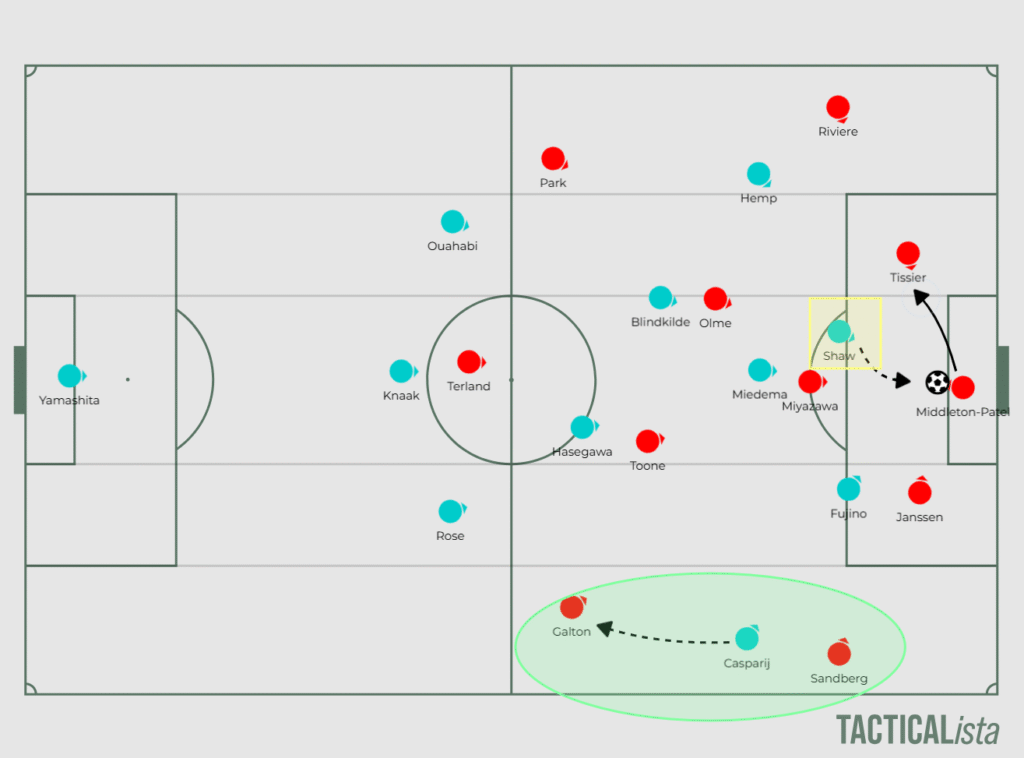
City would set-up in a player-oriented press, but Casparij would retreat as soon as United played down their right flank.
Although City did a good job to generally force United to play down one side before going long or losing possession, there were still some moments where the visitors managed to play through. Either using wide connections or direct attacks, United showed glimpses of their threat in this phase.
However, it is worth mentioning that United still could have done better to use City’s tactics against them. Marc Skinner could have instructed Middleton-Patel to play into the forwards to engage in the 3v3 since City clearly wanted to avoid it. Or, a bolder but riskier option, would be to try and funnel through United’s right, bait Casparij to advance, and then switch play to the left-back, Anna Sandberg, who would be free to receive in space.
Furthermore, United continued deploying their 4-3-3 shape in the middle third whilst City sat back in a 4-4-2/4-5-1 block. The main aim from the home side’s perspective was to match United’s three player midfielder whilst having a surplus at the back.
Meanwhile, the Reds tried bringing their wingers narrow, which would pin the City fullbacks, before trying to find a late overlapping run from the United fullbacks. This can prove effective since opposition wingers are susceptible to being caught ball watching rather than tracking their player. Although United manage to string passes together to progress and pin City back, the final ball to piece the opposition defensive unit was missing – a constant theme throughout the game.
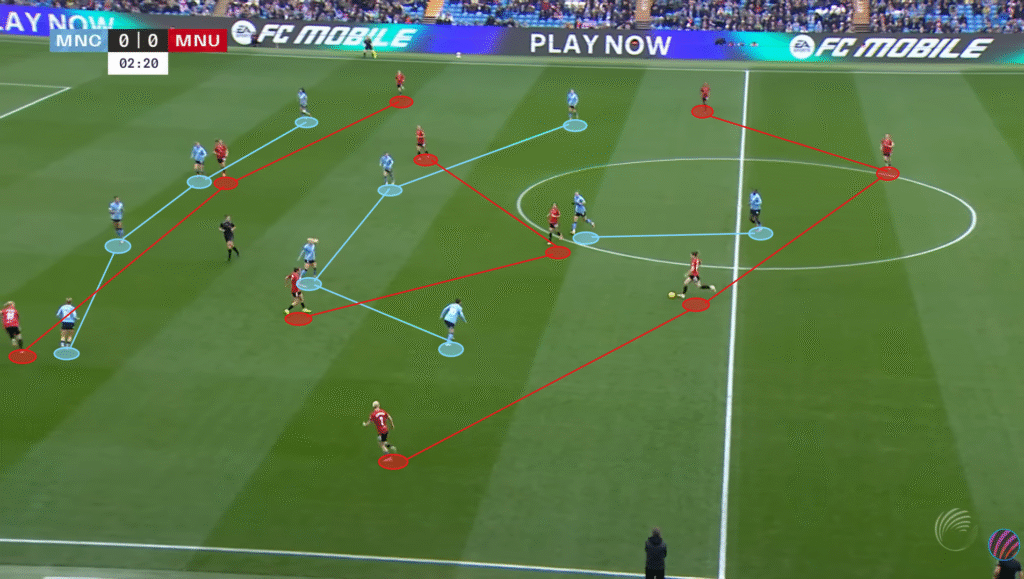
United’s 4-3-3 on-ball structure against City’s 4-4-2/4-5-1 mid-block.
City’s On-Ball Success: Generating advantages in build-up and causing tensions in the attacking half
The Blues had more joy in possession phases with numerous details playing a part. Firstly, during build-up, in the first half specifically, United’s 4-5-1 pressing shape afforded the City center-backs and goalkeeper enough time to play around Elisabeth Terland. Especially with the central defenders, Jade Rose and Rebecca Knaak splitting wide, there was too much distance for Terland to cover and cause any problems.
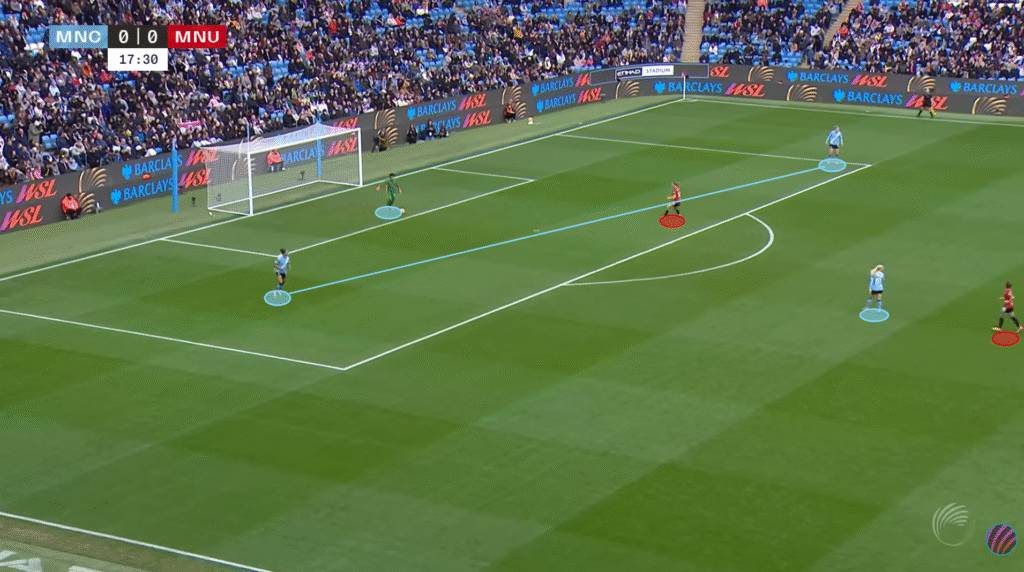
City’s wide center-backs made it impossible for Terland to cause any issues in the press.
The defensive passivity in this phase from United in the first half meant that they were easily pinned back into a mid or low block. From here, City would shift to a 3-1-6 structure, with Casparij pushing up. United found it difficult to cope here as City had structural advantages to generate advantageous wide connections.
Further, they would also use Casparij as an outlet to switch possession toward after dragging United to City’s left side. United were yet again generally passive in this phase since, even when they tried pressing up, City had a player surplus at least in their first line to bypass pressure. All these factors contributed toward the home team looking like a threat when they had the ball.
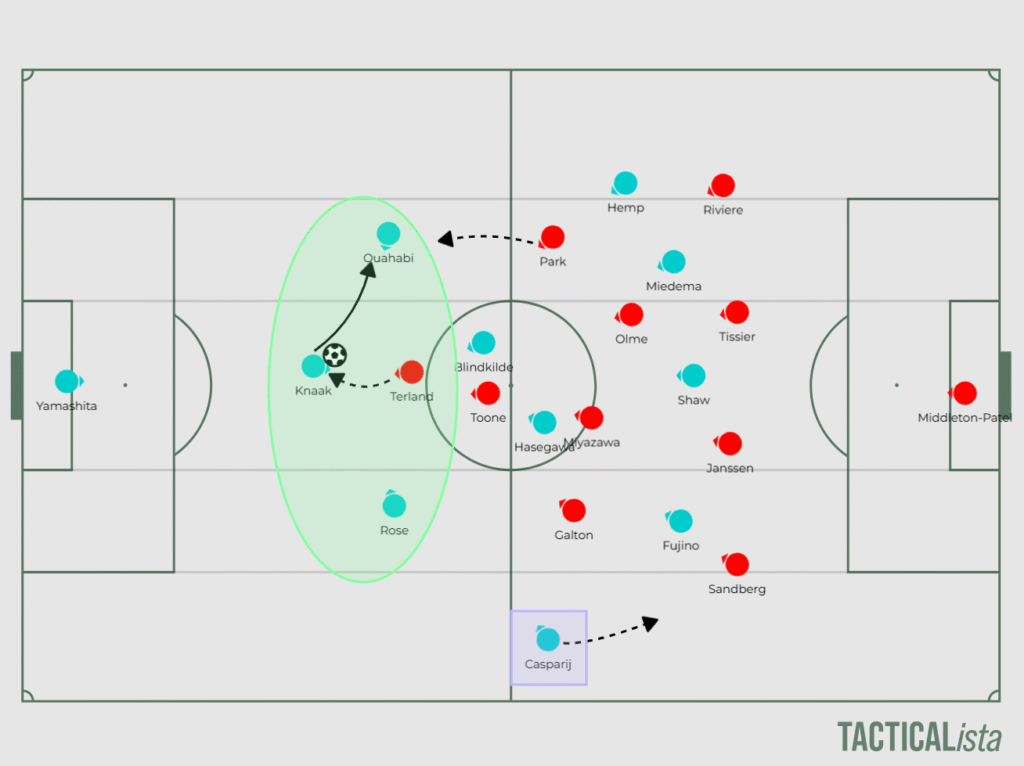
City’s in-possession structure and United’s mid/low block.
City 1-0: Failing to cover the critical area during the corner
After probing United’s defensive for the opening quarter of the tie, City finally produced a breakthrough from a set-piece situation. As explained in the below post, City carefully targeted Shaw to win first contact at the back post and guide the ball to the critical area – the zone targeted for the second ball (marked in green in the image).
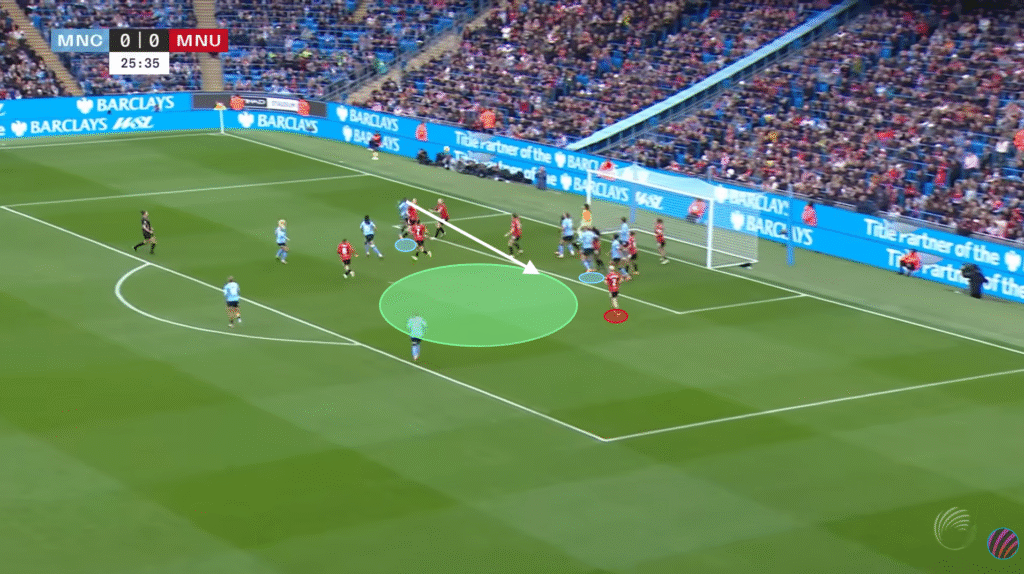
Shaw directed her header to the critical area from which Knaak scored.
This zone was unprotected, which allowed Knaak to capitalize. Skinner may look back at this clip and think that Sandberg could have done a bit better at being proactive to identify this zone. However, that might also be considered too harsh as it is also just well-worked by City.
City 2-0: Shaw’s clever blindside run
The Blues were dominant after going a goal up and extended this lead late in the half. The move starts with a marauding run from Rose. All the way from center-back, she carried the ball forward before playing it Casparij in space on the right, who curled a first-time ball across.
Not only is the cross inch-perfect, but Shaw’s run is really intelligent. She initially positions beside Dominique Janssen before darting on the blindside. The shift in movement was so quick that Maya Le Tissier could not react in time to cover Shaw either.
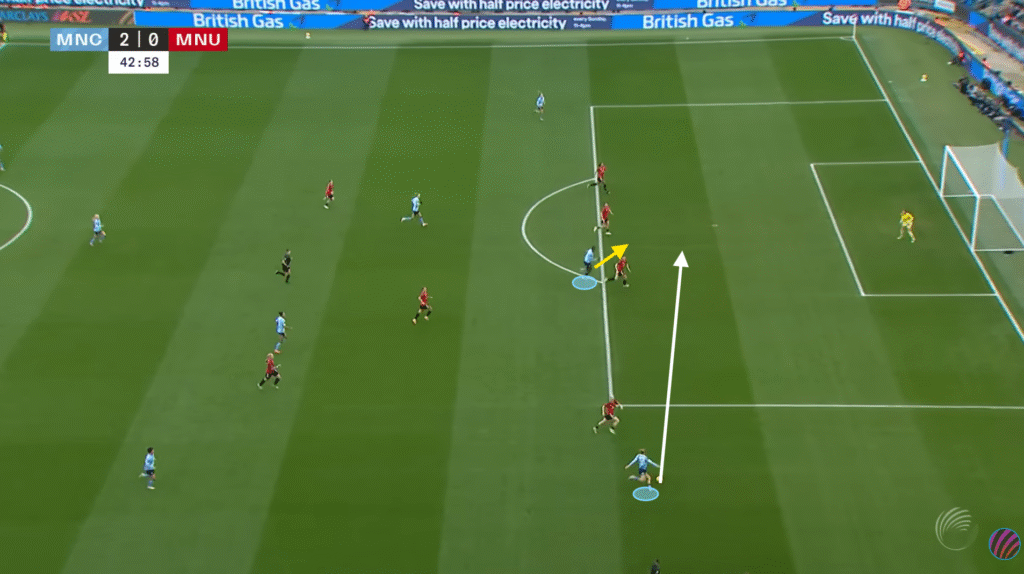
Casparij’s excellent delivery and Shaw’s smart run created City’s second goal.
City 3-0: Hemp seals the derby
Jeglertz’s intense and aggressive out-of-possession tactics were a factor to City’s third goal. However, the majority of the credit undoubtedly falls to Lauren Hemp, whose spectacular effort from outside of the box found the top corner.
Conclusion
With Chelsea picking up a surprise 1-1 draw against last-placed Liverpool, City creeped up to top the WSL table whilst having a three-point gap to the reigning champions. That should give them enough encouragement to maintain their momentum and form. With no Champions League fixtures to deal with, Jeglertz can focus on the league and push City toward a historic achievement. The manner of the defeat would have undoubtedly frustrated Skinner despite the overall positive season so far. Tactically, it might have even been a lesson for the United manager to be more daring with his high press choices and be willing to absorb more risk – like he in the second half by going player-for-player. Maybe he does not have to lean in too far but have a strategy like City’s with slight adjustments to decrease the risk.