
Manchester United reached the international break as one of the WSL’s two unbeaten sides so far this season, with the other being Chelsea. United have also had a winning start in Europe, beating Brann, Valerenga, and Atletico Madrid in their Women’s Champions League matches so far.
Brighton only lost two league games at home last season, and were unbeaten at home this season prior to this match. They were beaten away at Arsenal last time out in the WSL, but will have been looking to cause an upset against United on home turf.
United’s possession: Park’s free role
The away side were on top during the first half, able to play most of the game in Brighton’s half and create most of the chances. A highlight for them, as it has often been this season, was the performance of Jess Park, who was given tactical freedom in United’s system.
Park nominally started as a right winger in a 4-3-3 shape, but when United had the ball she would drift into midfield areas. She often indented into the right halfspace, either positioning herself between the lines, or coming deeper to collect the ball, which released right central midfielder Julia Zigiotti Olme to make forward runs into the vacated space.
United’s right back Jayde Riviere was also quite aggressive with her attacking runs, again facilitated by Park’s indenting. When Park was on the ball, she showed the ability to skip past opponents who pressured her as well as picking out well-timed passes.
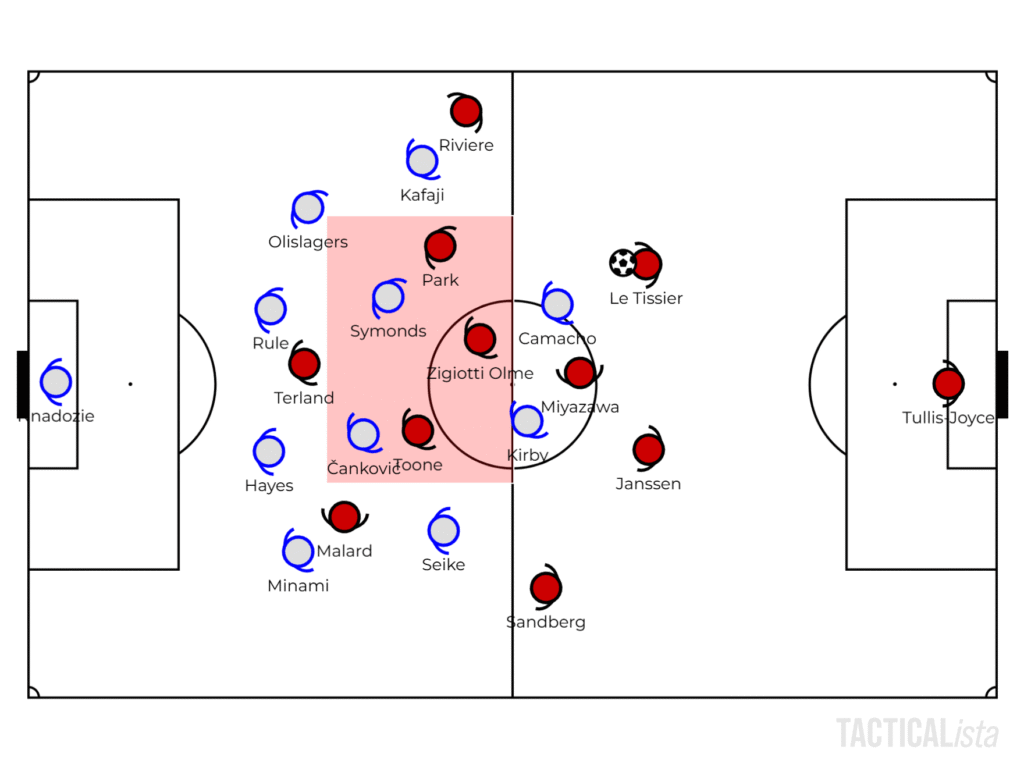
Zigiotti Olme tended to start from deeper positions, close to Hinata Miyazawa who generally played as the deepest midfielder. Toone and Park would then start from the more advanced halfspace positions, but both having freedom to drift across the pitch.
This meant that United were able to create overloads in the midfield areas thanks to these four players. Brighton’s wide midfielders in their 4-4-2 defensive shape generally tried to track the United fullbacks’ forward runs rather than tucking in to stay compact with the central midfielders, which further opened the halfspaces for United and exacerbated the effects of the central overload that United had.
At the same time, United had presence against the last line of Brighton’s defense with Elisabeth Terland as striker as well as Melvine Malard who started from the left wing and often occupied the left channel between Brighton’s right back and right center-back, looking for space in behind.
Thanks to their midfield overloads, United enjoyed the better of the first half, and managed to take the lead just before half-time as Park found the net with a low shot on the turn, just inside the Brighton box.
United’s pressing: from 4-1-4-1 to 3-5-2
Marc Skinner’s side also had the intent to pressure high against Brighton where possible. Their pressing initially started from a 4-1-4-1 shape against the 4-2-3-1 buildup shape of Brighton. United’s two more advanced central midfielders Zigiotti Olme and Toone would mark Brighton’s two deeper midfielders, while Miyazawa would sweep up behind them.
When United pressed, Terland often started slightly closer to Brighton’s right center-back, which directed the play towards Brighton’s left. When this happened in higher pressing moments, United would commit to the high press by transitioning into a temporary 3-5-2 shape.
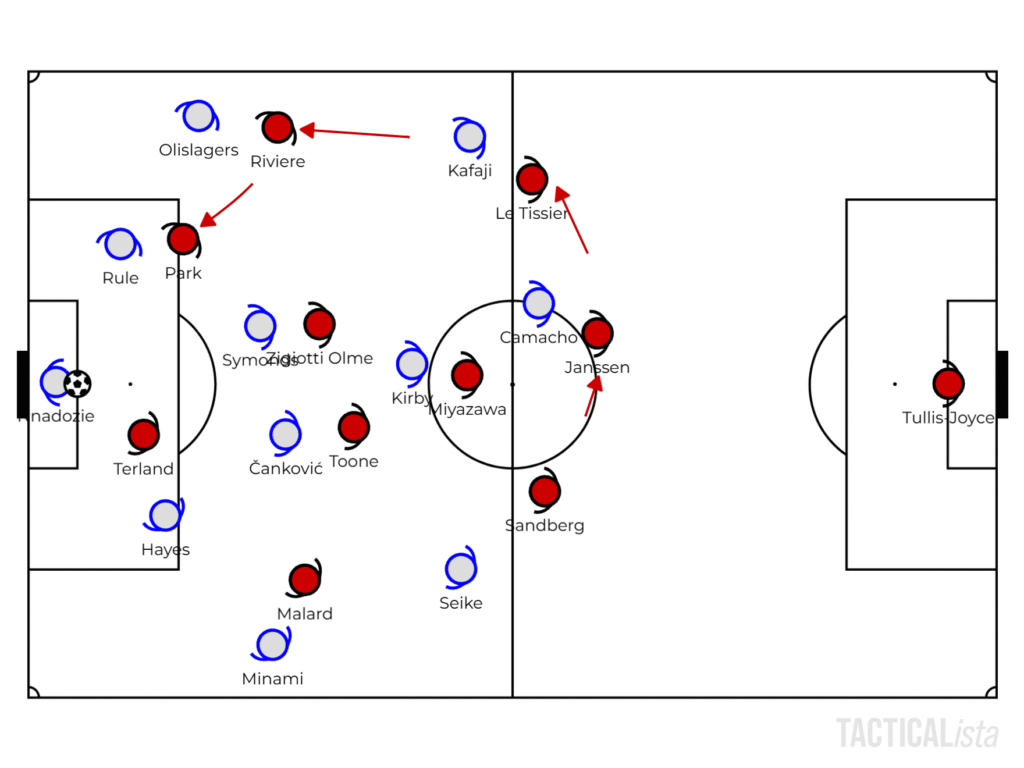
This was achieved by Park jumping up alongside Terland to pressure Brighton’s left center-back, while Riviere would then push forward towards Brighton’s left back, and the United backline would shift across accordingly, with Maya Le Tissier coming out to cover the right flank.
When Brighton did try to escape this left-sided trap, they often sought right-winger Kiko Seike, who sometimes found herself with more space due to the United left back needing to shift across to cover more central areas in the aforementioned high pressing phases.
The pressing setup was relatively effective for United and helped them stay on top in the first half. Their second goal early in the second half also resulted from them pressing high in this shape.
Brighton attack: second-half aggression
Being behind in the game, the emphasis was on Brighton to take an aggressive approach with and without the ball to try and level things up. They also made a change at half time, as Maelys Mpomé replaced left winger Rosa Kafaji. Mpomé played as right back, meaning Moeka Minami moved over to left back, and Marisa Olislagers pushed forward to the left wing.
Brighton would try to press United high in their 4-4-2 shape without the ball. On the whole, United’s midfield overloads plus the composure of their players meant that they were able to still put together relatively decent possession phases despite the renewed aggression from Brighton.
There were a couple of exceptions though. They had a warning shot when a lapse of concentration from Le Tissier on the ball allowed Seike to get in behind and end up hitting the post. A while later, a Brighton high press was able to force a United long ball, and the resulting turnover ended with Kirby receiving at the edge of the box and beating the United goalkeeper with a low, controlled finish.
United had also made changes at this point, with Hannah Blundell, Simi Awujo, and Fridolina Rolfö replacing Riviere, Toone, and Malard in like-for-like swaps. Despite the added pressure of a one-goal margin, United continued to play relatively well, and tried to persist with their own high-pressing game where possible.
Substitute Lisa Naalsund added a third late on for United after having replaced Zigiotti Olme, and Seike’s goal in stoppage time proved too little, too late for Brighton who were defeated at home for the first time this season.
Conclusion
Brighton’s midfield was overwhelmed in the first half due to United’s overloads and Brighton’s own defensive scheme which left their two central midfielders somewhat isolated and the halfspaces exposed. In the second half, they were able to play their way into the game with more aggression on both sides of the ball, but it was not quite enough to make the comeback.
United showed some nice features in and out of possession here. With the ball, their 4-3-3 system with Park indenting to overload the midfield worked excellently, with Toone and Park creating great synergy in attacking midfield areas. Against the ball, their high press was ambitious but effective and directly resulted in their second goal.