
Chelsea remain unbeaten in their last thirty domestic games but will have been disappointed to drop points away at Manchester United last time out, such are the high expectations that have been set for Sonia Bompastor’s side due to their dominance in the Women’s Super League. The Blues were also held to a draw in the Champions League in midweek by FC Twente.
Tottenham meanwhile have impressed under new coach Martin Ho at the start of the season. Cathinka Tandberg arrived from Hammarby in the summer, and has led the line well for Spurs, netting three goals in the opening five matches.
Chelsea’s pressing: Tight Midfield Marking
The home side were able to establish a large possession share in this game, partly due to their pressing which helped to limit the effectiveness of Spurs’ buildup. This allowed Chelsea to play most of the game in Spurs’ half.
Spurs would build up in a 4-2-3-1 shape, while Chelsea matched them up player-for-player in a 4-3-3 formation. Wieke Kaptein and Erin Cuthbert as the two advanced midfielders for Chelsea were especially important in their tight marshaling of Spurs’ double-pivot. It was difficult for Spurs’ center-backs to find Olga Ahtinen or Eveliina Summanen in buildup, and they often had to look wide or long.
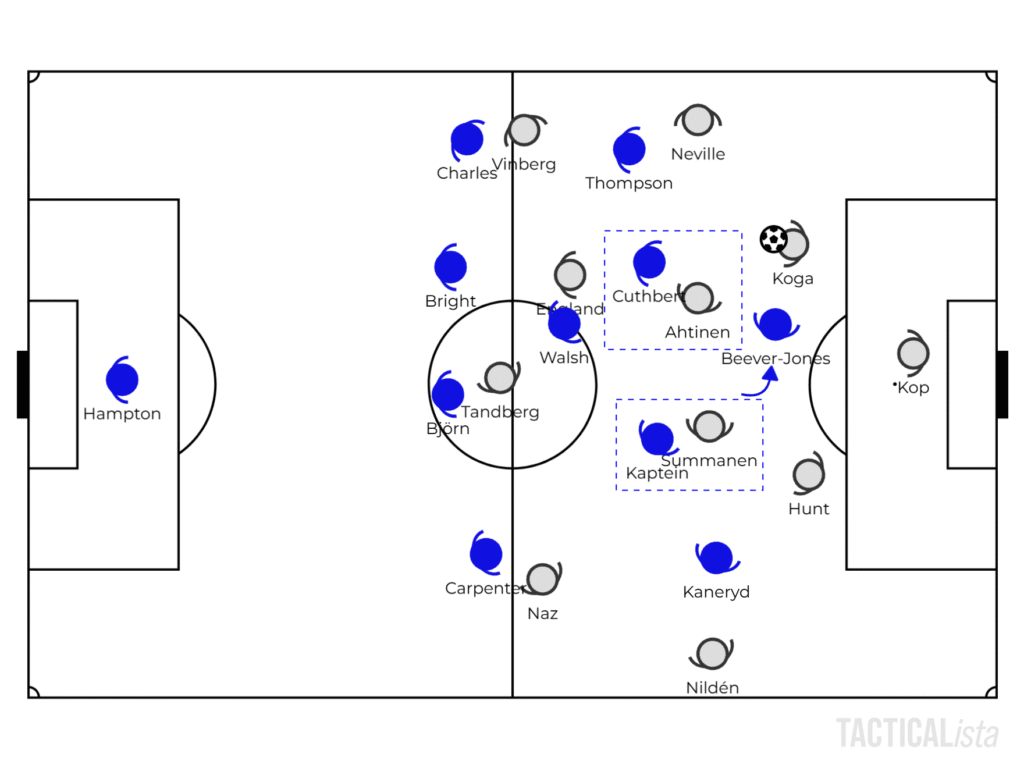
Spurs’ central midfielders did not help in this respect as they were often a bit static, not finding the appropriate movements or timings to get separated from their markers in order to offer options for the player on the ball.
Chelsea’s striker Aggie Beever-Jones would often attempt to curve her pressing movements in order to cut the connection between Spurs’ center-backs in order to prevent quick switches across the backline. Meanwhile in deeper positions, Keira Walsh was generally responsible for tracking Beth England, and one of the Chelsea center-backs would follow Tandberg if she tried to drop into midfield.
Chelsea’s Defensive Transitions: Signs of vulnerability
The occasional vulnerability shown by Chelsea in defensive transition was mentioned in last week’s match analysis. They also showed signs of this against Spurs, especially in the early stages, after which they were able to keep things more under control.
The issue stemmed from the fact that the rest-defense could be somewhat understaffed at times when the fullbacks moved forward along with both central midfielders who had license to run beyond the forwards.
When this happened, Walsh could often be isolated at the base of midfield, with large spaces either side of her into which Spurs could attack. The good thing for Chelsea was that the intensity of their recovery runs was strong, and Spurs were not clinical enough to really take advantage of these moments.
Spurs’ defending: Weakness on the wings
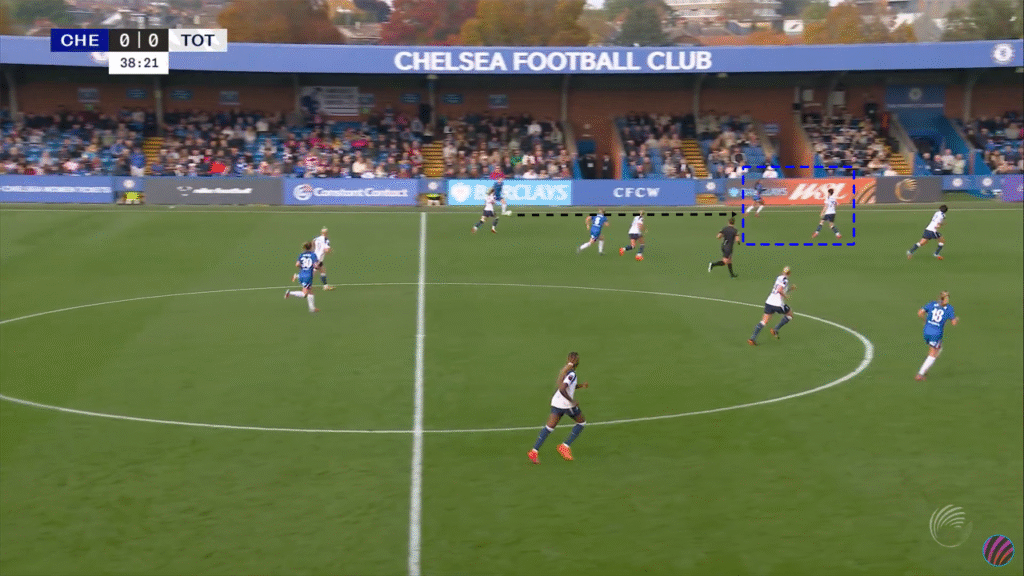
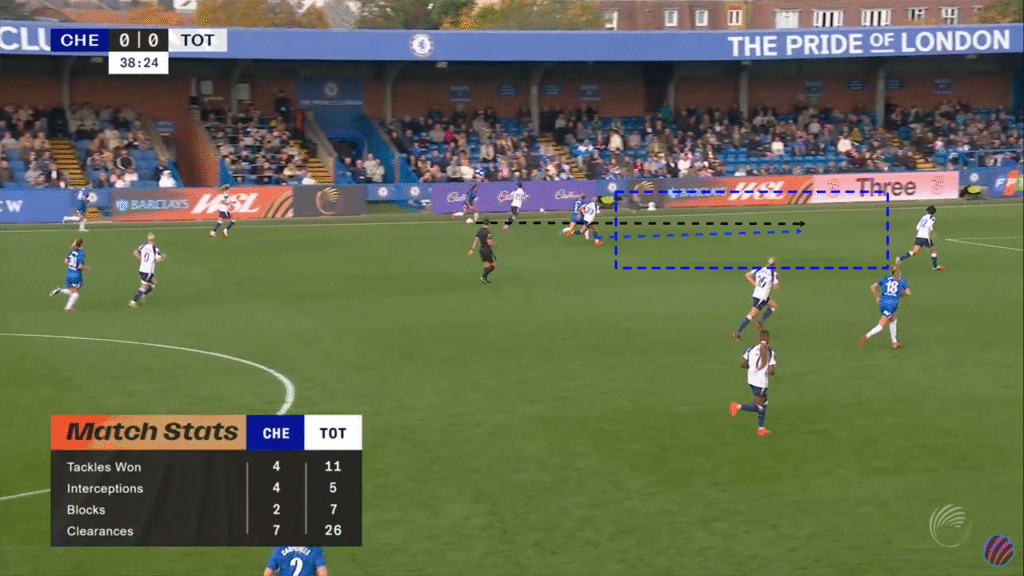
Defending in their 4-2-3-1 shape, Spurs showed significant defensive weaknesses in the wide areas against Chelsea’s attack. They had particular problems on their right side, where Chelsea winger Alyssa Thompson was a livewire for the whole game with her sharp off-the-ball movement and her dangerous dribbling.
Spurs’ defensive reference points were a bit looser than Chelsea’s in midfield. England would generally try to mark Walsh in the number six zone, while the central midfielders would track Kaptein and Cuthbert, but not as tightly as the Chelsea pair did to them in possession.
In terms of their right-sided attack, Chelsea often had the option of playing more directly towards Johanna Rytting Kaneryd, who liked to spin off into the space behind left back Amanda Nildén at every opportunity.
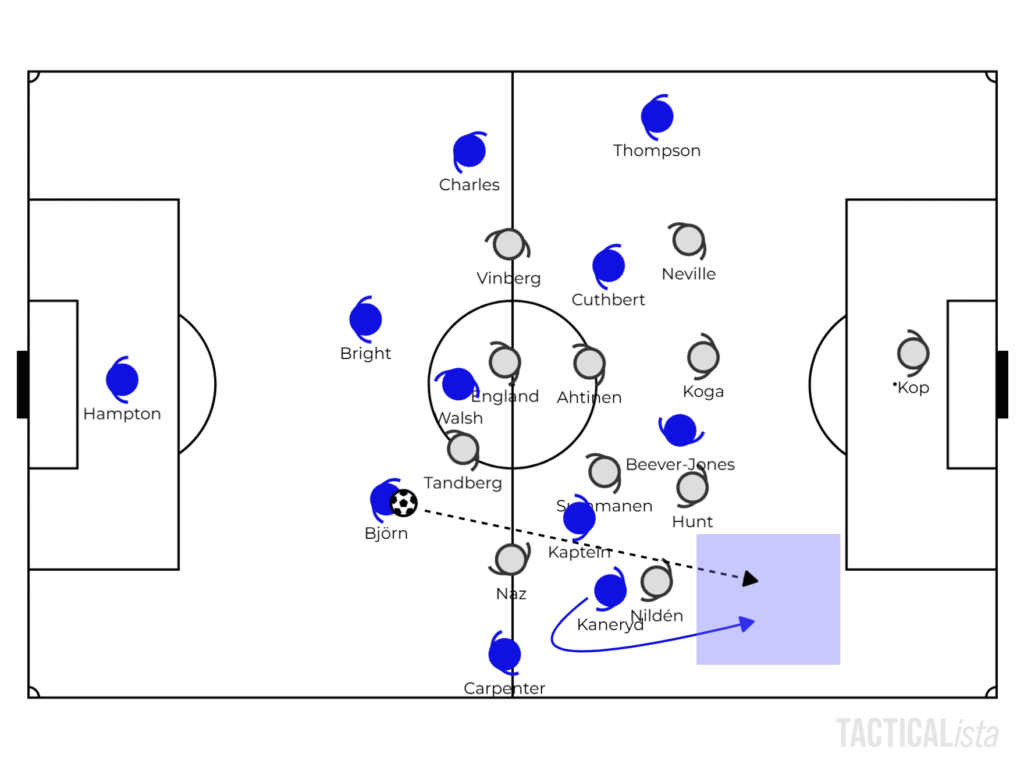
Ellie Carpenter was also an active attacker down this side, making some excellently timed overlaps and underlaps which Jessica Naz struggled to track. These could also be supplemented by Kaptein’s movements into depth, targeting the channel between Spurs’ center-back and fullback on this side.
While Chelsea attacked well on their right side, their left side is where they really profited. Firstly, as mentioned, Thompson was extremely dangerous on this side. She showed excellent movement, including double-movements to drop off into space or get on the blindside of Ashleigh Neville.
The Spurs right back had an extremely difficult time on this side, making positional errors which led to her often finding herself on the wrong side of Thompson, allowing the American winger to receive the ball in dangerous positions far too easily. Once Thompson had the ball, she had the beating of Neville in terms of pace too.
There were also some issues in the implementation of Matilda Vinberg’s pressing on this side. She wanted to try and jump up onto Chelsea’s left center-back at times. Other times, she was deeper but not adequately positioned to actually cut out or pressure passes into Chelsea’s left back Niamh Charles.
This made it far too easy for Chelsea to progress the ball down this side and reach Thompson. Cuthbert would also be advanced in the left halfspace, ready to run beyond the Spurs defense in a similar manner to Kaptein on the other side, or get into pockets of space between the lines.
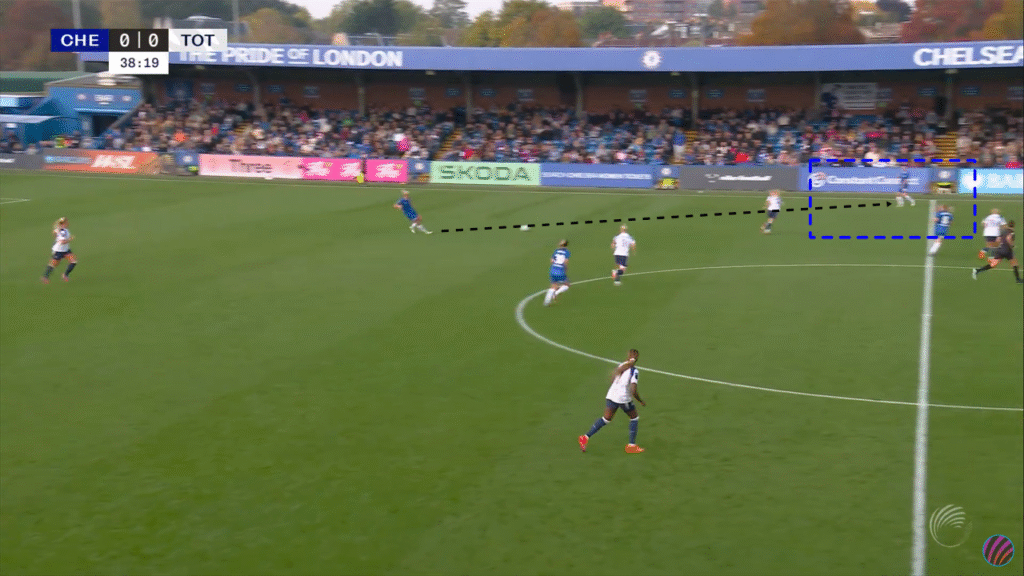
Below is an example of Spurs’ defensive problems on this wing. In this scene, Chelsea are able to go from their own half to the edge of Spurs box with three unpressured passes.
1-0 Chelsea: Walsh shows her quality
Despite the dominance of Bompastor’s side, they had to be a little patient to finally get their goal. The goal seemed inevitable, as they were turning up the heat on Spurs as the game progressed, and eventually they found the net just after the hour mark.
The goal came courtesy of Walsh, who showed good composure in using her body shape to misdirect England, before teeing herself up for a low, driven shot from distance which nestled into the corner of Spurs’ net.
This goal would ultimately be the difference between the two sides, with Spurs not really creating any convincing attacking pressure for the remainder of the game. It was Chelsea who continued to look more dangerous in attack, and they also had the luxury of bringing the likes of Guro Reiten and Sam Kerr off the bench to freshen things up.
Conclusion
The scoreline suggests a close match, but Chelsea created plenty of chances here and deserved the win overall. Thompson was outstanding on the left, and their wing attacks in general were dangerous all game. On the defensive side, there were some transition vulnerabilities at certain times, but their organized defending looked comfortable.
Spurs can take credit for their emergency defending around the box, with key blocks and tackles from their defenders keeping this game level for as long as it was. From a group and individual tactical perspective though, the way they defended on the wings was a big problem, with neither fullback able to adequately mark or cover their direct opponent, and the wide midfielders struggling with the advanced positioning and runs of the Chelsea fullbacks.