


Sonia Bompastor’s Chelsea have set a ridiculously high standard to such an extent that a draw was considered a rare points drop. Their impressive undefeated run still holds with 30 domestic matches that Chelsea have not lost.
For Manchester United, however, holding the reigning champions to a draw is a massive result. Further, Marc Skinner’s side have also commenced the season positively, having lost just one match so far in a tricky Champions League away fixture to SK Brann.
As Skinner later highlighted in an interview, it was an entertaining competition for the neutrals, with many interesting and high-level tactical battles making it an intriguing watch. The major talking point in the opening minutes had to do with Chelsea’s open rest defense structure.
Manchester United’s Counterattacks: Exploiting Chelsea’s weakness between the lines
The Blues boast immense personnel quality, leading them to have more possession against most opponents. Due to their propensity to engage in many transitional attacks, they do not dominate possession like Arsenal do, for example. Looking at the 2024–25 campaign as well as the ongoing season, Chelsea rank fourth for most possession.
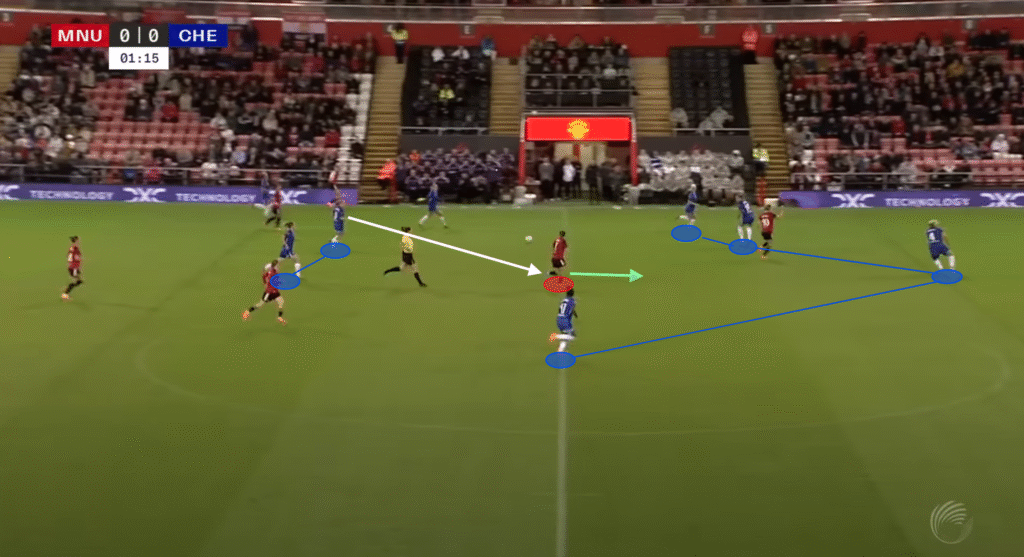
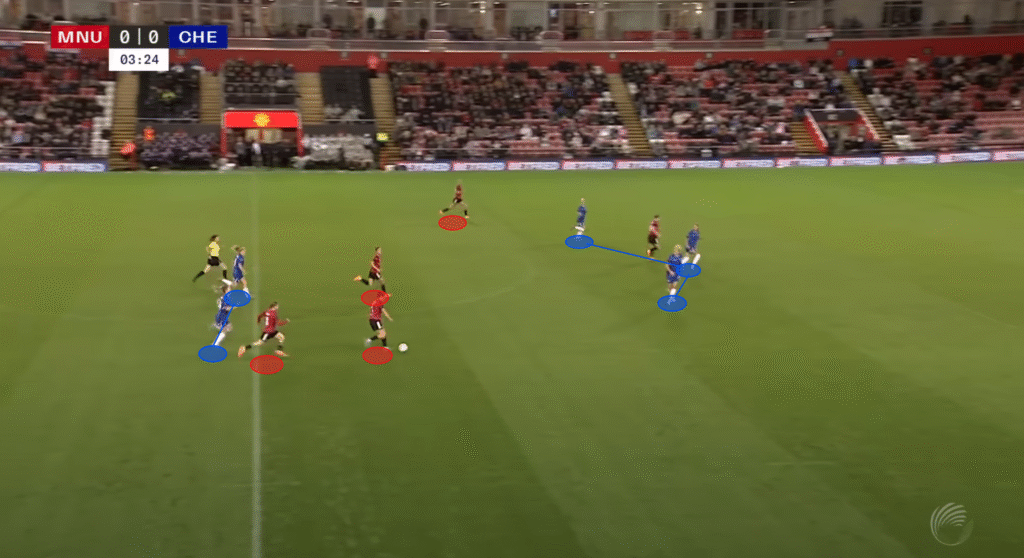
Nevertheless, the point still stands that they often have to deal with defensive transitions, and in this phase, the rest defense is key—not only in terms of structure, but also the distances maintained by the midfield and defensive lines.
In the early period against United, there were two moments that highlighted an early weakness in Chelsea’s game—conceding vast space between the lines. This was exploited by United, leading to two dangerous chances in the first five minutes.
Chelsea’s Attacking Threat: Late runs from the fullbacks
Once pinned back, the home side defended from a 4-5-1 block. Against this, Chelsea structured in what can be described as a 4-2-4 shape. However, as we know, the formations only tell us so little, but they help us visualize what that sort of looks like on the field.
Bompastor instructed both wingers to cut infield, allowing for late runs from two attacking fullbacks, Ellie Carpenter and Sandy Baltimore. This was a valuable weapon in the arsenal since the late movement from the fullbacks could catch the opposition wingers off guard, who, understandably, are not laser-sharp defensively.
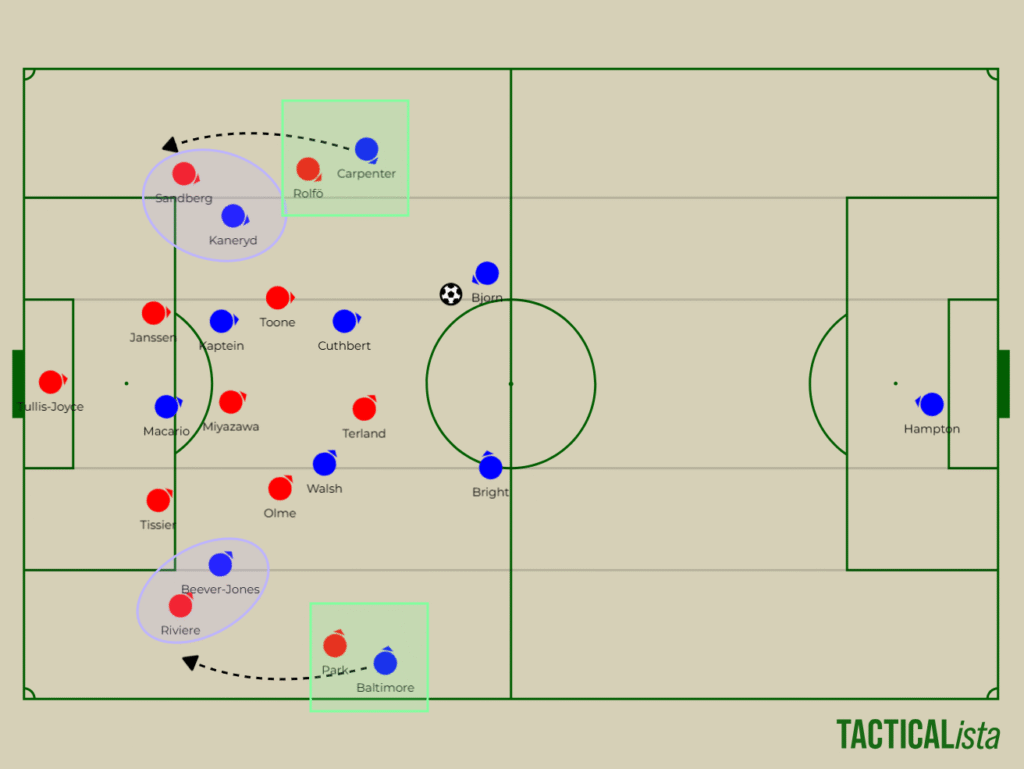
This was evident through a chance in the 6th minute, where Carpenter received the pass on the overlap, with the United left winger, Fridolina Rolfö—who should be doing better to spot the run—caught ball-watching. Carpenter’s exceptional delivery was met by Aggie Beever-Jones, who missed from close range.
0-1 Chelsea: Intense pressure and swift counter
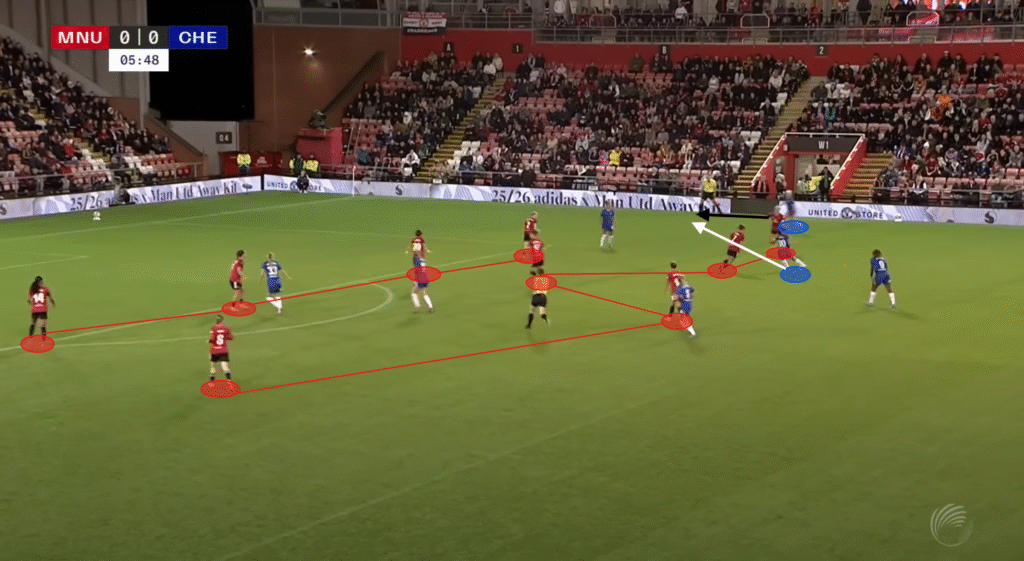
Bompastor has usually preferred the Blues to use a pendulum press so that they can maintain a player surplus at the back. For context, the pendulum press refers to a tactic wherein two markers press three players of the team that have ball. The objective is to use angles to cut off the pass into the free player.
For example, as we can see below, when a center-back passes the ball to her partner, a player from the defending team (Macario) presses the initial passer (Tissier). Meanwhile, the other marker (Kaptein) presses the receiver of the pass (Janssen) whilst cutting off the angle to the defensive midfielder (Miyazawa). This makes it difficult for the on-ball player to find a straightforward pass, as all her teammates would be tightly marked.
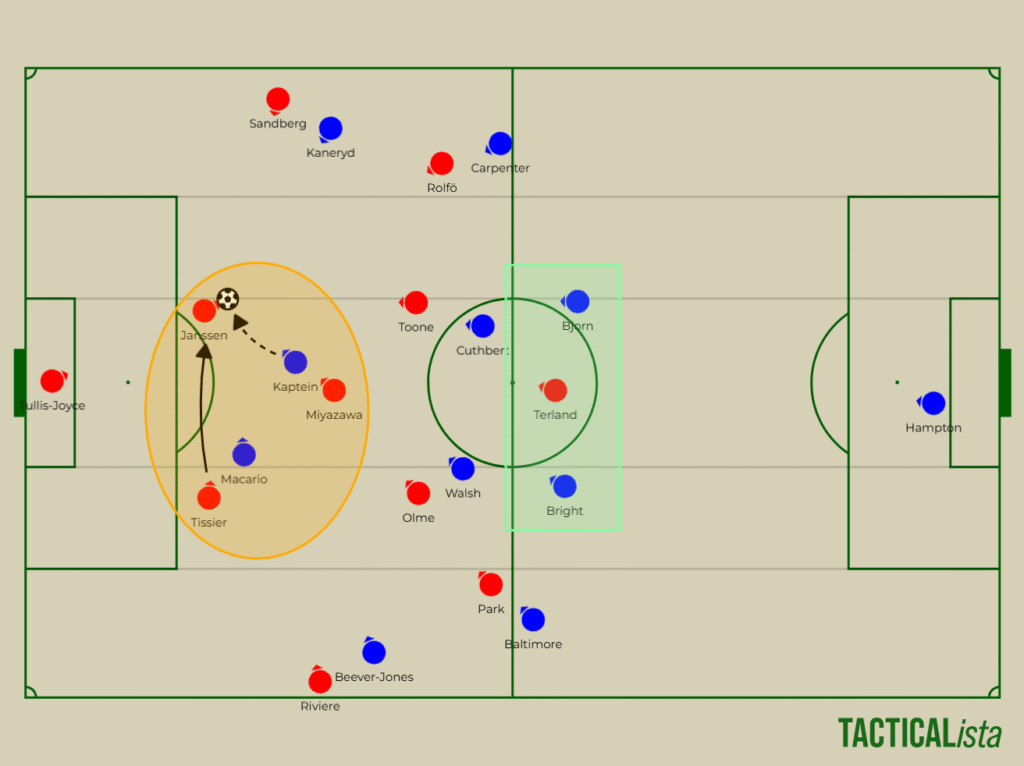
To pull off the pendulum press, it is important for the defending team to time their movement and apply the right intensity. Chelsea, one of the best off-ball teams in Europe, generally execute this tactic to a high standard.
Against United, this worked and directly resulted in the first goal. In the play below, Hinata Miyazawa cleverly pulled off from Wieke Kaptein’s cover shadow. However, since Catarina Macario cut off the passing angle to both center-backs, Kaptein could pressure Miyazawa and still allow Chelsea to keep a surplus at the back.
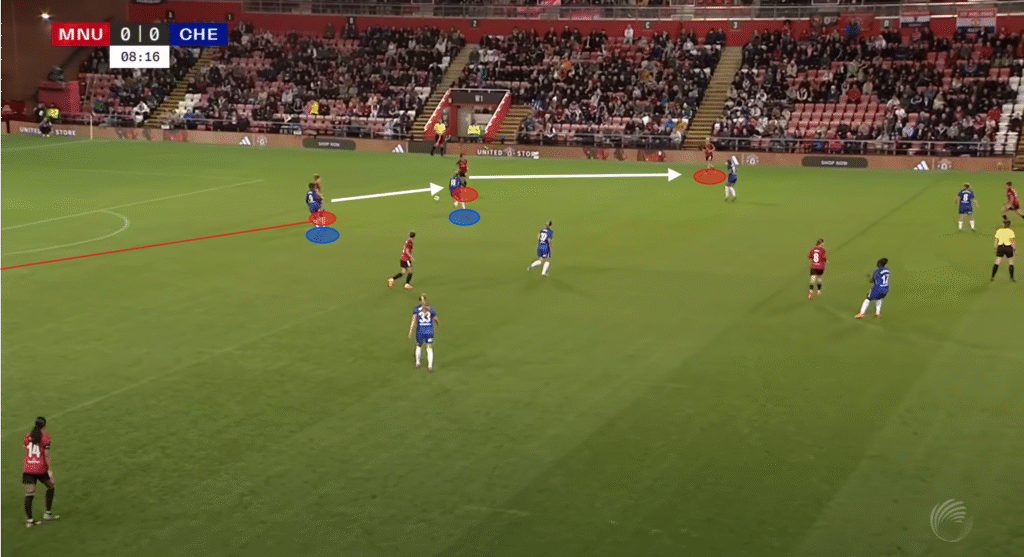
Hence, Miyazawa was rushed into a pass to the left-back, who was instantly pressured, leading to a turnover. This soon resulted in a goal for Chelsea as Kaptein got on the end of Macario’s shrewd backheel.
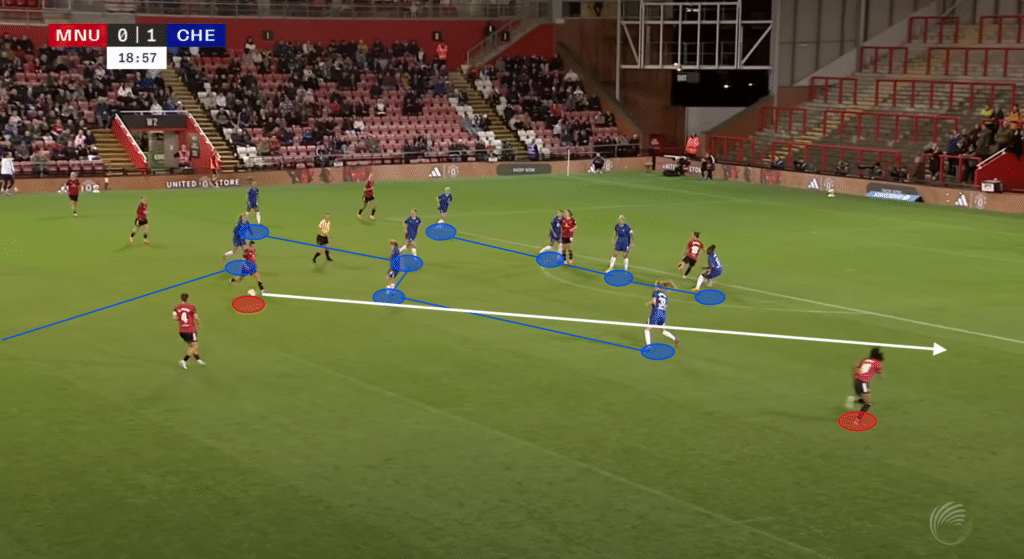
Admittedly, United dealt with Chelsea’s pendulum press better as the first half wore on. The center-backs and defensive midfielder were able to circulate possession well, whilst the United forwards cleverly peeled off the opposition backline to receive the ball unmarked.
1-1 Manchester United: Attacking fullbacks and flooding the penalty area
United similarly employed attacking fullbacks who provided late overlapping runs to catch the Chelsea wingers off guard. Moreover, once pinning the opposition back in their 4-4-2 defensive block, United tried to flood the box with numbers to make the most out of their crosses.
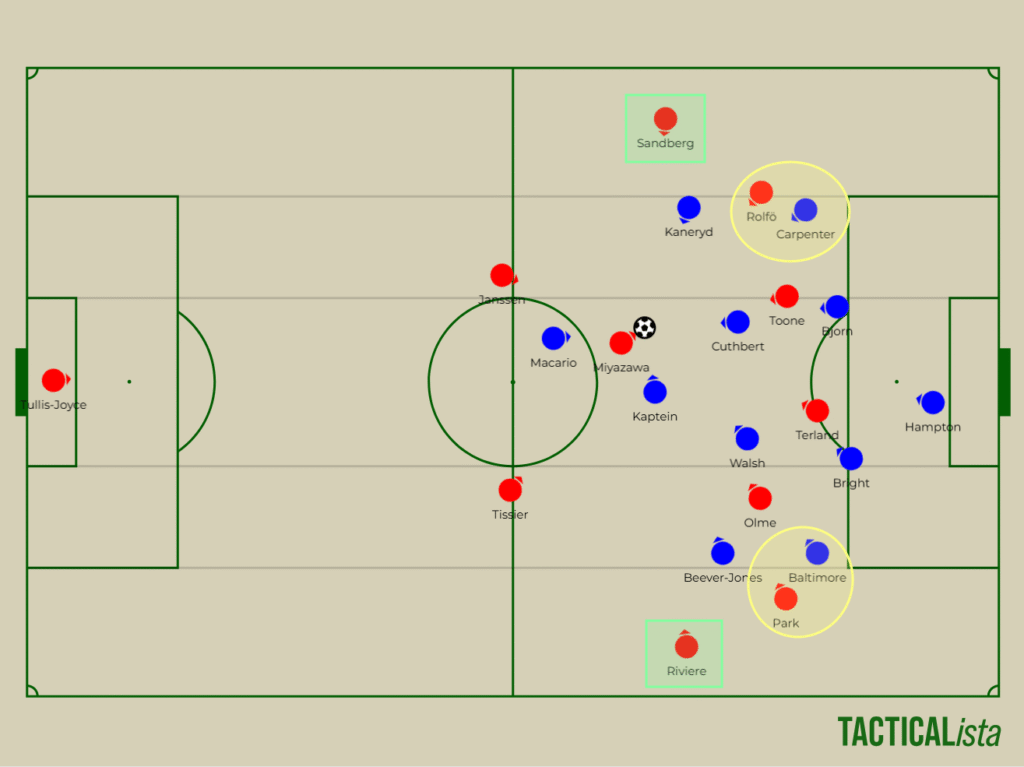
In the 19th minute, Ella Toone dropped deeper to string passes for United and managed to find the overlapping Jayde Riviere, who was on the blind side of Beever-Jones. She did not deliver the cross into the box since the initial pass was slightly overhit. Thus, Riviere passed it back to Maya Le Tissier, whose cross into the penalty area eventually bobbled to Sandberg.
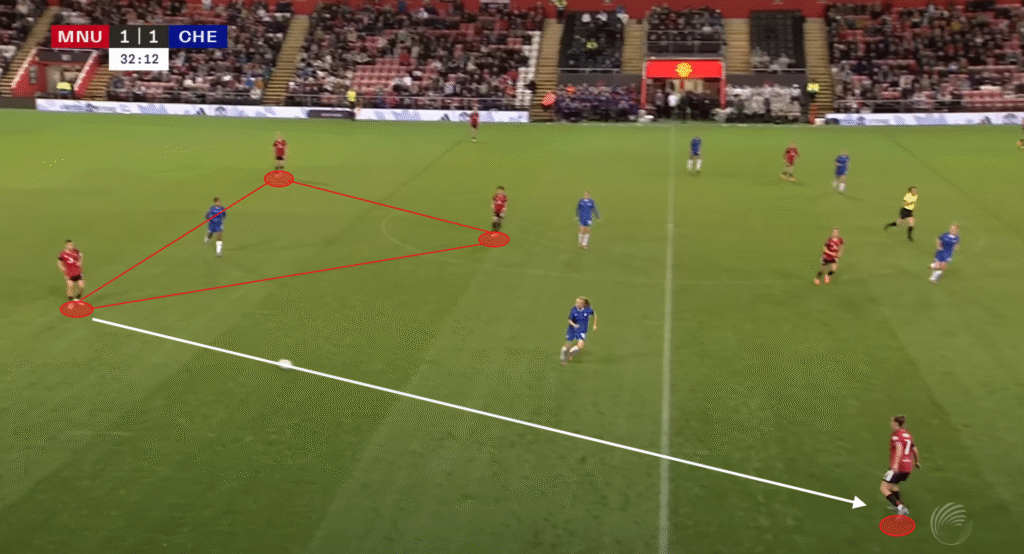
The bullet strike from the left-back found the far bottom corner, and there was nothing Hannah Hampton could do to stop it.
Missed Opportunities: Golden chances to go ahead wasted
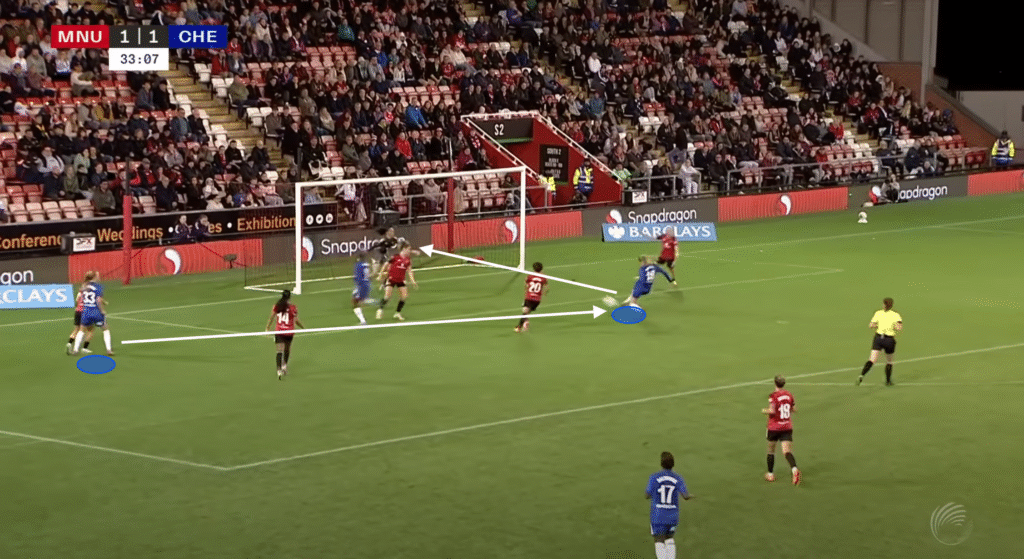
Although United grew into the game more and managed to equalize soon after they were trailing, Chelsea managed to generate valuable chances. However, they were inefficient with their finishing and missed quality opportunities. In the first half, they had fewer shots but had the chance below, which should have been converted.
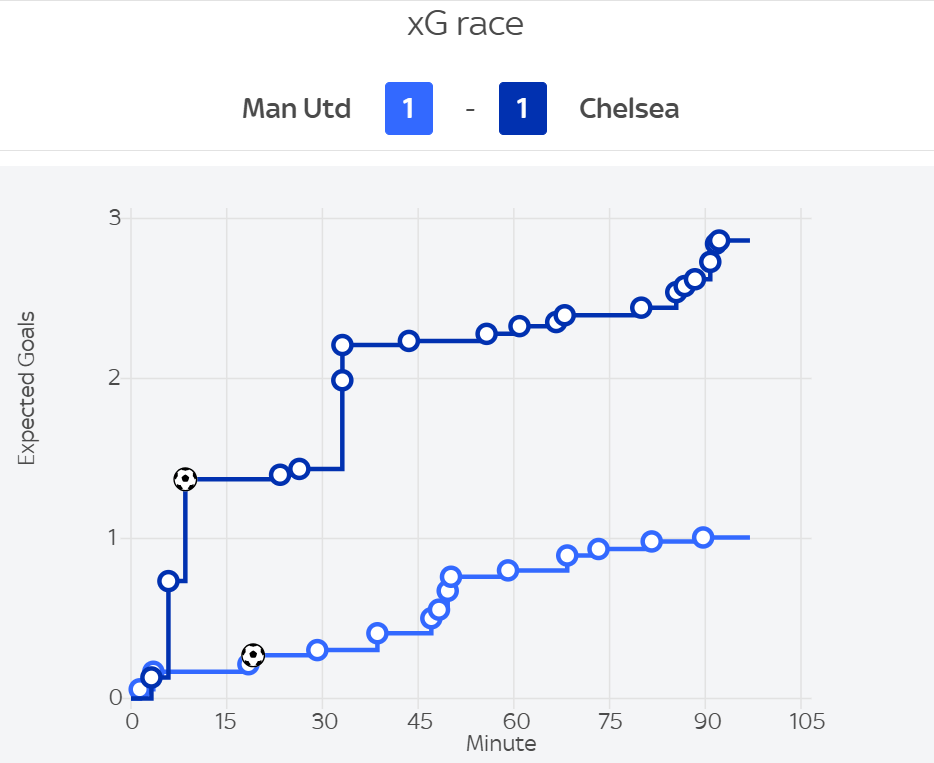
As for the second half, Chelsea produced slightly more in terms of volume. This was also the case for United, who looked threatening in the opening few minutes of the second period as they had consecutive shots on goal. Below is the expected goals (xG) graph from Sky Sports.
Bompastor was the first manager to make a substitution as she brought on the newly signed and talented Alyssa Thompson for Kaptein. This meant that Beever-Jones occupied a central role, whilst Thompson played as the left winger. Skinner also made an attack-minded change by taking off Elisabeth Terland for Melvine Malard, who has most often got minutes as a substitute in the 2024–25 campaign but started the first four domestic matches this season.
Neither team could affect the scoreline in the second half, but this was not due to a lack of trying. Despite the pouring rain in Manchester, both sides did not compromise on their energy and intensity whilst maintaining the same tactics with which they started the match.
Conclusion
In the end, it was a competitive match where both teams created a fair volume of chances. Bompastor might be slightly the more frustrated manager out of the two since Chelsea generated more in the final third. Nonetheless, United, to their credit, also performed to a good standard.
In a weekend where the two other main title competitors, Manchester City and Arsenal, faced off, with the former earning the win, as covered by Josh Manley, Chelsea are just separated by a point. Tottenham are close, as they are also a point behind. Interestingly, they will face Chelsea in the coming weekend.
It might be a little too early for United to consider themselves title-contender level, having finished sixteen points adrift of Chelsea last season. Hence, the current campaign will be more focused on closing that gap to a reasonable extent and hopefully building on that in the following years to dethrone Bompastor’s Blues.