


Two Women’s Super League giants met this weekend as Manchester City took on Arsenal in a match which already threatened to have implications for the title race. Both sides were looking to keep pace with a Chelsea side who had dropped rare WSL points on Friday with their draw against Manchester United.
Under new coach Andree Jeglertz, City had started the season relatively strongly prior to this match, having won their last three games after their opening day defeat to Chelsea. Arsenal meanwhile had dominant wins in their first two matches but stuttered slightly last time out, dropping points at home to Aston Villa.
Arsenal’s High Press: Forcing the opposition to the right side
Renée Slegers’ side were keen to put a high press on City’s buildup in this game. They started their pressing from a 4-4-1-1 shape which would then form a 4-4-2 when Mariona Caldentey jumped forward from her number ten position to pressure Jade Rose when she was on the ball.
Arsenal’s pressing usually directed the play towards City’s right side, with Alessia Russo’s higher positioning on Alex Greenwood’s side making it harder for her to get on the ball. Once Rose received, Caldentey would pressure, and the Arsenal central midfielders would try to get tight to the City midfielders closest to the ball. Similarly, Katie McCabe and Caitlin Foord would get tight to their opposite numbers on Arsenal’s left side.
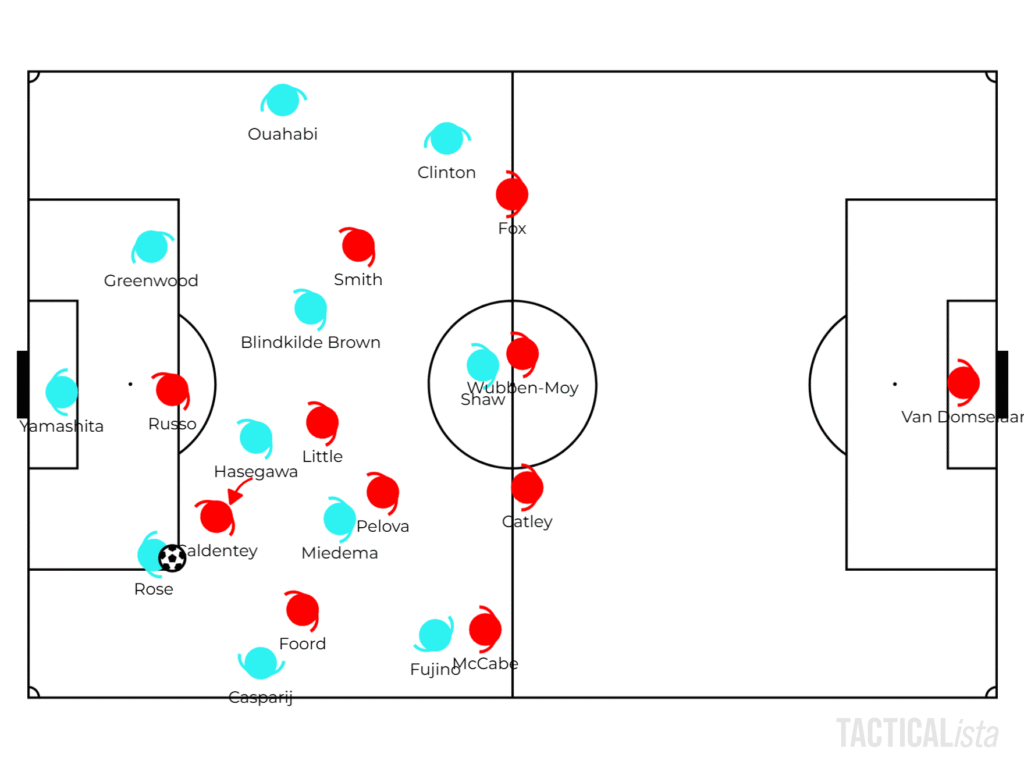
This Arsenal strategy of directing City to this side of the pitch and then squeezing the play worked well on some occasions. City were not necessarily unhappy to be forced into more direct play though, because long balls allowed them to use Khadija Shaw’s physicality in aerial duels and look for knock-downs.
Sometimes Shaw was a bit isolated in this respect, lacking the supporting runs to make the most of her flick-ons. However, City’s first goal did stem from a long ball up to Shaw to bypass the Arsenal press, with City winning the second ball in midfield and launching a right-sided attack which culminated in Shaw heading in Kerstin Casparij’s cross.
The other way that City could sometimes break the Arsenal press was through the occasional lapse from Arsenal’s front two in the use of cover shadows when trying to screen passes into midfield. Yui Hasegawa in particular was able to find some pockets from which she could then make connecting passes through the Arsenal midfield. In general, Hasegawa was City’s most composed presence in possession, able to bring respite in a game where Arsenal slightly edged the possession share overall.
City’s Offensive Tactics: Usage of attacking fullbacks
When City had established possession in Arsenal’s half, they liked to push the fullbacks forward to provide width, allowing the wingers to invert. Leila Ouahabi was often the more aggressive fullback in this respect, while Casparij would sometimes start deeper before joining attacks at the opportune moment.
In midfield, Hasegawa usually stayed around the number six area looking to dictate play, while her central midfield partner Laura Blindkilde Brown moved flexibly, sometimes dropping closer to the center-backs, and sometimes pushing forward. Vivianne Miedema had a relatively free role against her former club, roaming through the midfield to find pockets of space.
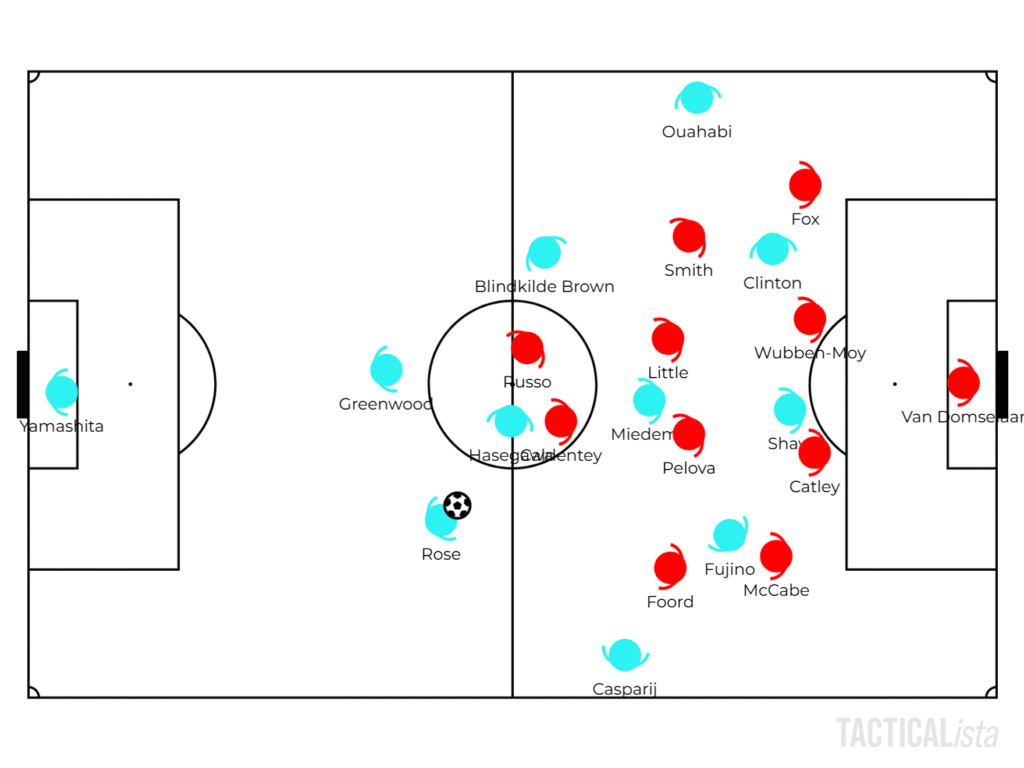
Arsenal were defending in a 4-4-2 shape in these phases, with the wingers having to focus on tracking City’s attacking fullbacks, or finding the appropriate moment to hand their opposite number on to the Arsenal fullback behind them.
Overall though, City’s organized possession phases were not their most decisive moments of the game. Some of their best attacks came from transition moments where they could run at an exposed Arsenal backline.
Arsenal’s Build-Up: Ambitious possession play
The reason that City were able to have transitional moments against an exposed Arsenal defense was that Arsenal’s possession play was relatively bold. They were happy to take risks playing through the middle in deeper areas, and were sometimes sloppy in doing so, losing the ball in dangerous situations.
A key feature of Arsenal’s possession play was the inverting of their left back, McCabe. In deep buildup against a City high press, she would move in alongside Kim Little to create a double pivot, and Aoba Fujino was sometimes reticent to follow her so far into midfield, so McCabe was able to find space this way on occasions.
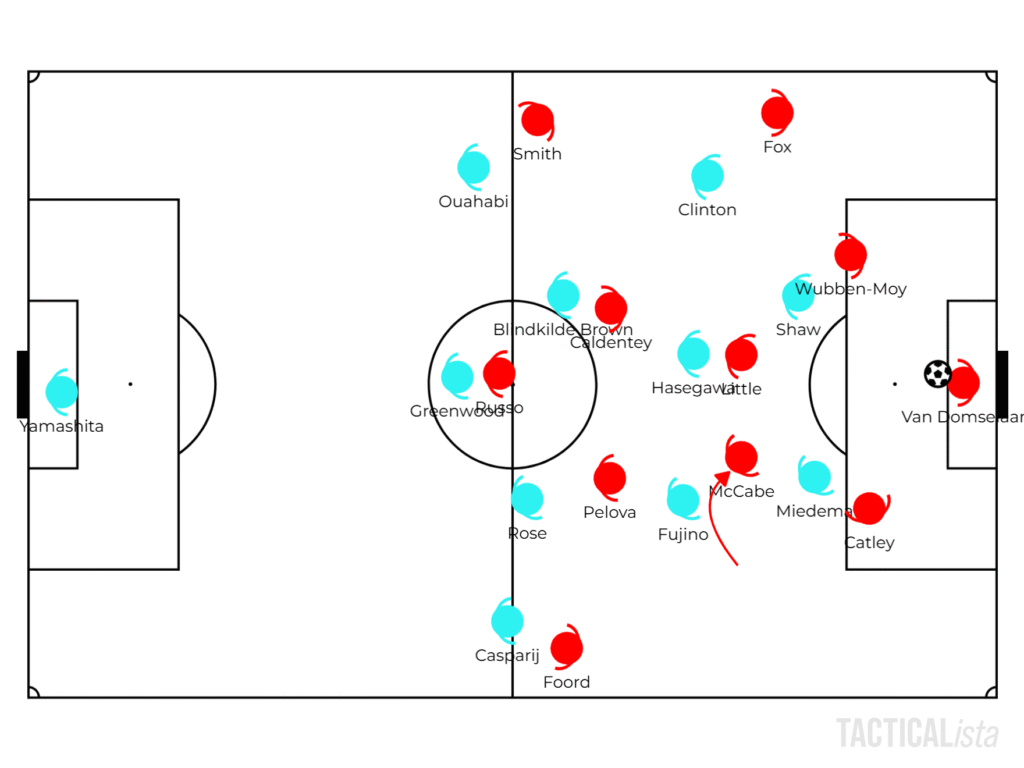
City would try to lock on player-for-player when pressing Arsenal’s buildup, with the central midfielders acting aggressively in pushing forward to mark and pressure when Arsenal played around the number six area. City started to see success in this pressing method, particularly towards the end of the first half, and Arsenal had some nervy moments with loose passes playing out of defense.
When Arsenal had the ball higher up the pitch, they sometimes formed a back three, with Emily Fox starting a bit deeper from right back, while McCabe pushed into midfield. Victoria Pelova had license to push forward in the left halfspace, or to float centrally, while McCabe’s movement would look to complement hers, either by staying deeper when Pelova was higher, or pushing through the left halfspace when Pelova dropped.
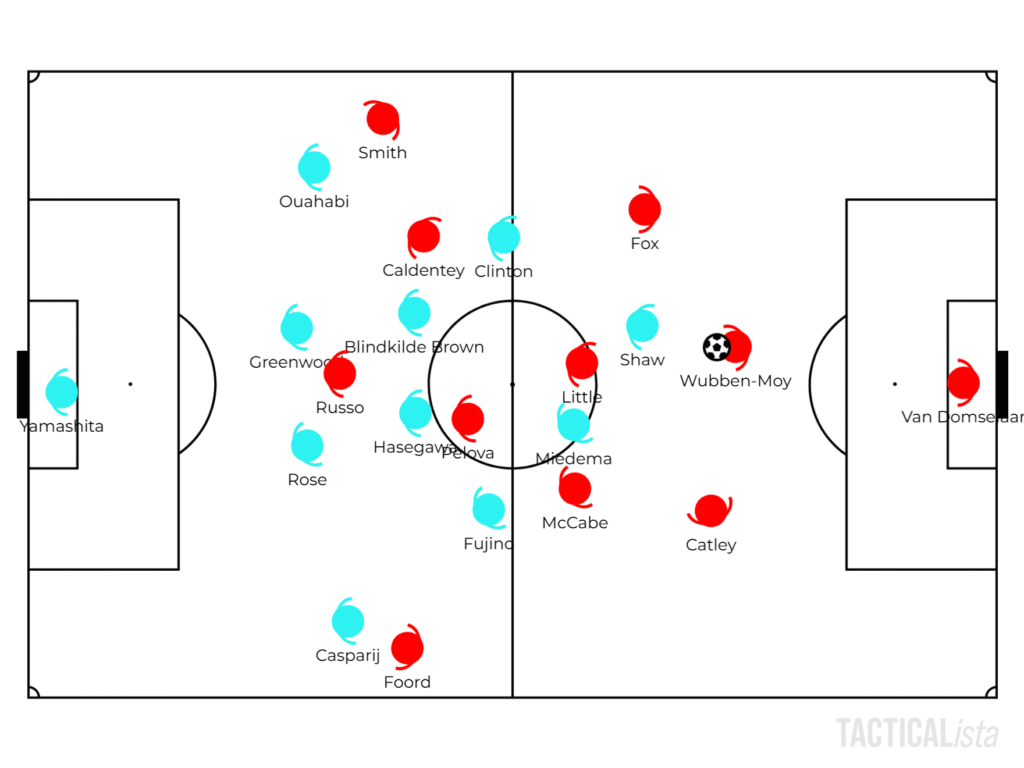
Little usually anchored the Arsenal midfield, while Caldentey frequently drifted across to the right halfspace, between the lines. Fox could also complement the right-sided dynamic from her deeper position by joining attacks, allowing Olivia Smith to focus more on running in behind.
Although Arsenal’s buildup play was not perfect, their idea of playing through midfield paid off in the buildup to their equalizer at the start of the second half, when Pelova was able to receive on the blindside of City’s midfield before spreading play to the right, where Fox was overlapping Smith. Her low cross was cut back to Caldentey, whose finish beat Ayaka Yamashita at her near post to make it 1-1.
Substitutions: Decisive changes and their impacts
Not long after equalizing, Arsenal went behind again as Casparij helped bundle the ball home from a City corner. Slegers reacted with a triple substitution, replacing Foord, Pelova, and Smith with Beth Mead, Stina Blackstenius, and Chloe Kelly.
The introduction of Blackstenius saw Russo move back to the number ten position, and Caldentey to a central midfield role, in order to allow the Swede to play up front. Kelly initially played on the right and Mead on the left, but they soon switched sides, and would remain in that configuration for the rest of the game. City had also made their first change at this point, bringing Iman Beney on for Clinton, with Fujino moving over to the left side to accommodate Beney on the right.
The game was a bit stretched at times in the second half as Arsenal chased the game. Kelly’s pressing from the left added some intensity though, and she would sometimes press diagonally onto Rose, helping rush City’s buildup from this side, with Arsenal then squeezing the left side in the usual manner.
This is actually where Arsenal’s second equalizer originated from, as they won the ball high up on the left, before finding Kelly on the edge of the box. Her deflected shot looped into the far corner, making it 2-2.
It was City’s own substitute who would have the final word though, as Beney scored the winner with two minutes of regular time remaining. It again came from a long pass towards Shaw, which the Arsenal defense were unable to deal with. She teed up Beney arriving in the box, who was eventually able to fire a low shot past goalkeeper Daphne van Domselaar. Arsenal threw the kitchen sink at City in the remaining minutes, but were unable to get their equalizer, giving City a crucial three points.
Conclusion
City played a more transitional game here, with many of their best moments coming from turnovers in pressing, or longer passes towards Shaw. In the end, this proved decisive for two of their goals. Their attacking fullbacks in possession were also promising, while their game without the ball was mostly decent.
Arsenal meanwhile showed intent with their high press, and managed to score from such a situation in the second half. On the ball, they had some nice ideas with McCabe inverting into midfield and helping to create overloads, while Caldentey also had some good moments. However, they were careless at times in giving away transitions, and struggled to deal with City’s directness.