
It was only right that the inaugural article for the platform covered the reigning and decorated Women’s Super League champions, Chelsea. On Sunday, Sonia Bompastor’s Blues had a London derby clash against Rehanne Skinner’s West Ham.
The two teams have had polar opposite starts to the domestic campaign, with Chelsea stringing together a three-game winning streak, whilst West Ham did just the reverse. That losing streak has included heavy defeats to Brighton and Arsenal, where they leaked nine goals. A clash against the league’s heavy hitters was not ideal but, if they could pull a shock win against all the odds, that might just spur the side on to shifting their momentum.
West Ham’s Build-Up: Importance of winning the second balls
Chelsea are known for pressing aggressively, and they were no different against West Ham, marking player-for-player against the opposition build-up. Skinner utilized a 4-2-4 shape, which is a common structure that managers opt for.
Left center-back Amber Tysiak steps up into midfield to form the double pivot with Oona Siren, whilst the left-back tucks in. Thus, central midfielder Inès Belloumou filled in at fullback.
With Chelsea locking on player-for-player, a pass into the pivot would be considered too risky due to how tightly they are marked. The options were to either tap into wide combinations or go long. The latter can still be used to their advantage if there is a good setup to win the loose ball. This would create an artificial transition, which can be advantageous against a scattered defense and with space to exploit.
In the 3rd minute, West Ham created a chance after going long immediately after the goalkeeper played a pass to the right center-back. Though Riko Ueki did not win first contact, Millie Bright did not get a controlled touch over the ball either.
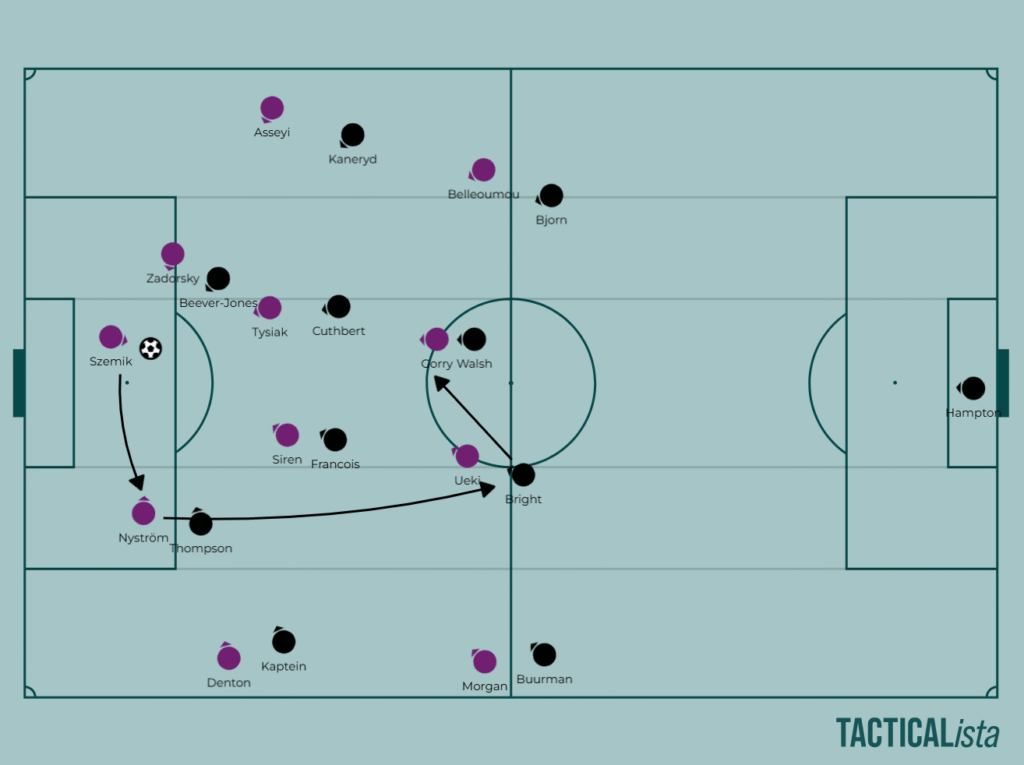
The second ball, however, was pounced upon by Katrina Gorry, who played a great ball across the box that the messy Chelsea backline could not intercept. It was still a tough ball for Viviane Asseyi to control since she was just a second late. A good early chance for the home team.
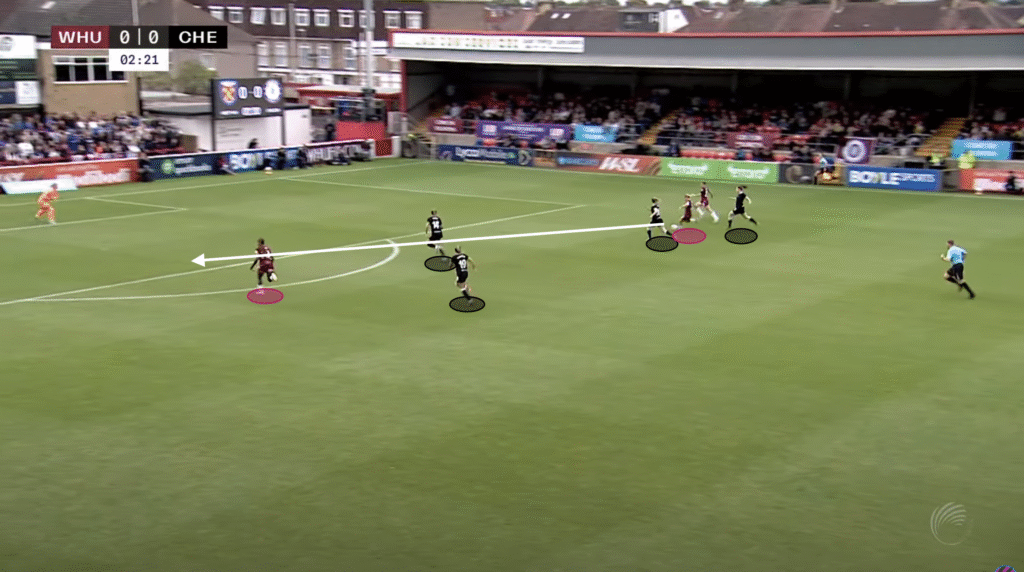
A few minutes later, there was an indirect opportunity created by playing this way. Nyström again went long after receiving the ball from Kinga Szemik, resulting in a throw-in. West Ham quickly took it, yet again ending up with Asseyi, who could not get a strong connection after attempting to strike the ball first-time.
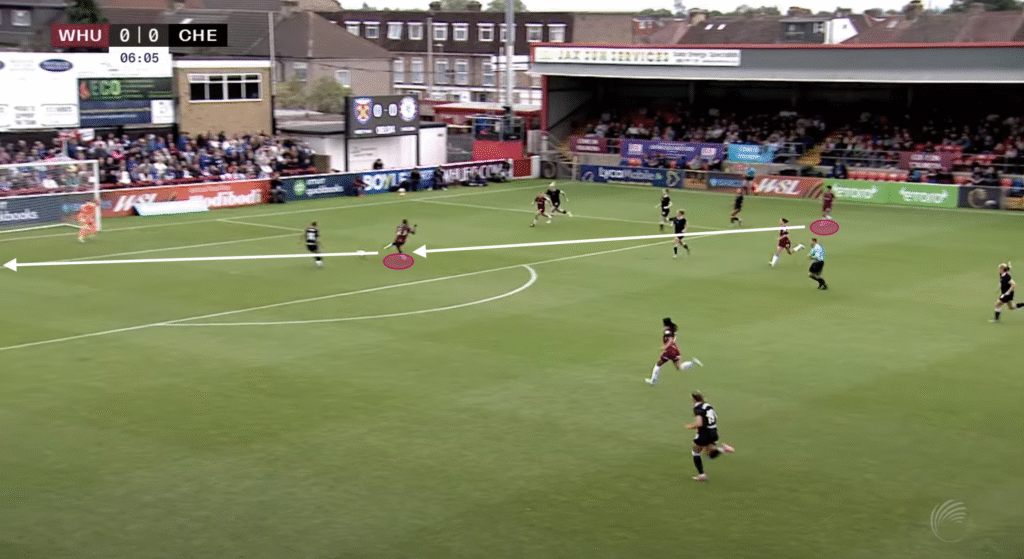
0-1 Chelsea: Beever-Jones’ wonder-strike
Despite the many tactical battles on the field, it was Aggie Beever-Jones’ brilliantly placed shot from a free kick that delivered the opener. The Chelsea academy graduate accurately slotted her shot into the top left corner, which was unsavable.
The free kick simply originated after Hannah Hampton went long from a goal kick. West Ham pressed high with a player deficit, yet Chelsea went direct. Beever-Jones, who the pass was directed to, was fouled and soon scored.
In transitional situations, West Ham continued to be a threat in the early period of the first half. There was another play in the 10th minute where a deep turnover led to a swift counterattack, resulting in a dangerous shot from Gorry, whose shot smacked the near post.
Chelsea’s Final Third Overload: Pulling apart the opposition backline
The visitors attacked in their usual 3-2-5 shape, whilst Skinner employed a 4-4-2 mid-block. This brought out certain positional superiorities out wide that had a ripple effect in the center.
When West Ham were pinned back, there was a wide overload on the flanks with the Chelsea wingback and attacking midfielder outnumbering the West Ham fullbacks. This resulted in the near-side West Ham center-back being dragged out to provide the support, with even Beever-Jones cleverly pulling out to the same side.
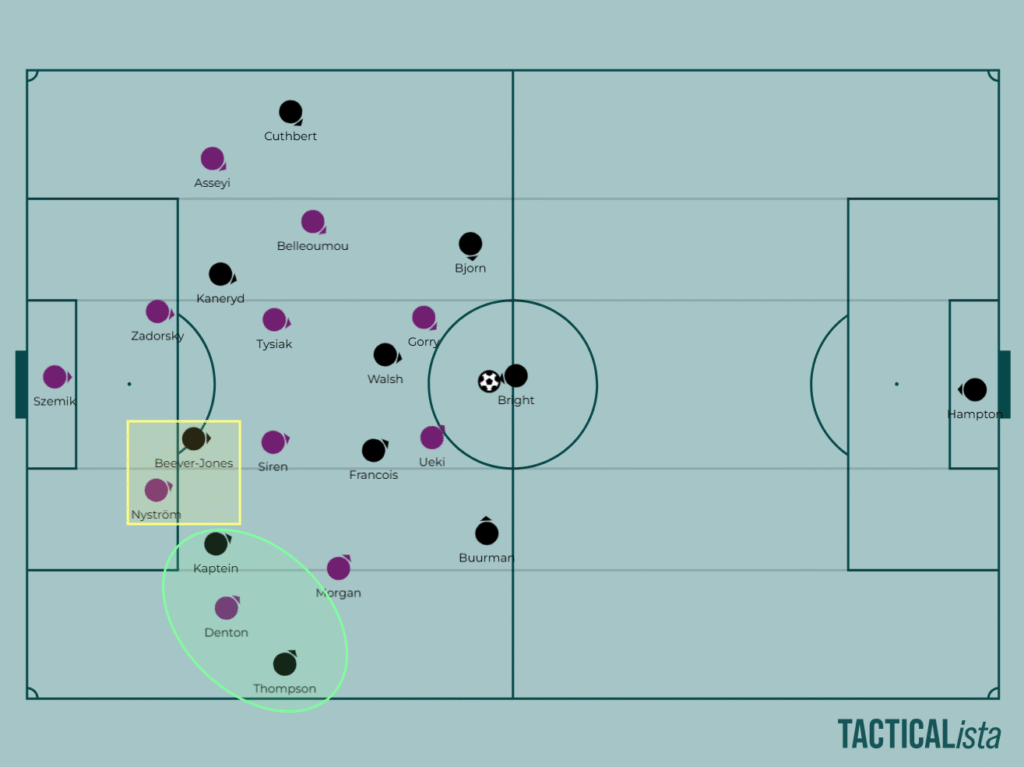
0-2 Chelsea: West Ham’s defense torn apart from wide overload
In one of Chelsea’s first attempts to break down a deep West Ham block, they managed to rip apart the backline and score. When the pass is played to Wieke Kaptein, both of West Ham’s right-side defenders are dragged across – leaving huge holes on either side of the left center-back, Tysiak.
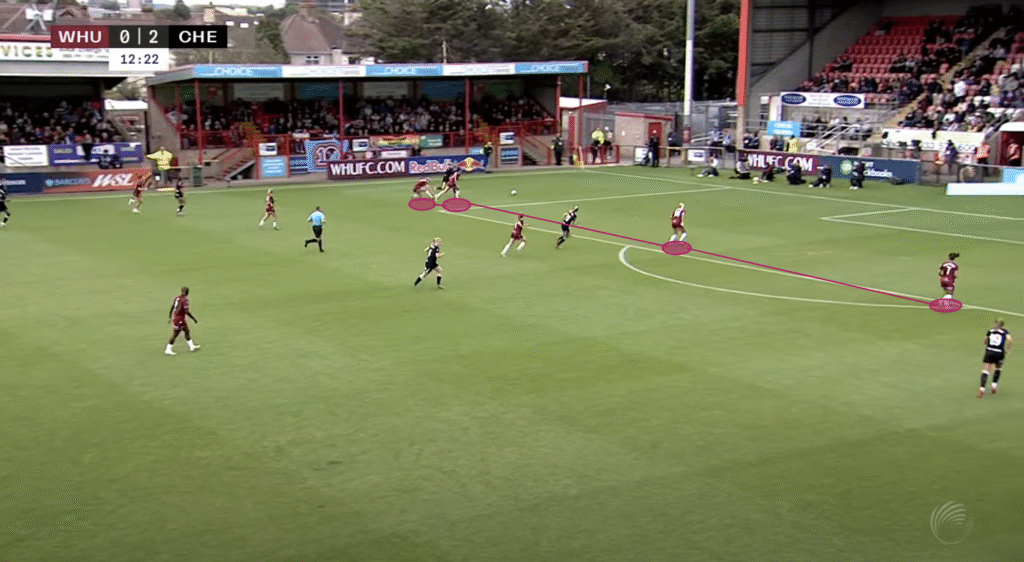
Thus, when the final ball from Kaptein to Johanna Kaneryd is delivered, there is a lot of room to attack, which the eventual goal scorer does. It was a neat but effective move from Chelsea.
Chelsea’s High Press: Aggressive press with clever angles
Bompastor did not have her team press player-for-player when West Ham progressed slightly higher up the defensive third. Instead, she tried to keep a surplus at the back by having Beever-Jones press both center-backs. By curving her run when pressing the defender with the ball, the Chelsea forward could keep the opposite center-back in her shadow cover.
With the right intensity in the press, the opposition could be forced to play direct. It may not lead to high turnovers but still a possession loss in midfield when the opponent is rushed to play forward.
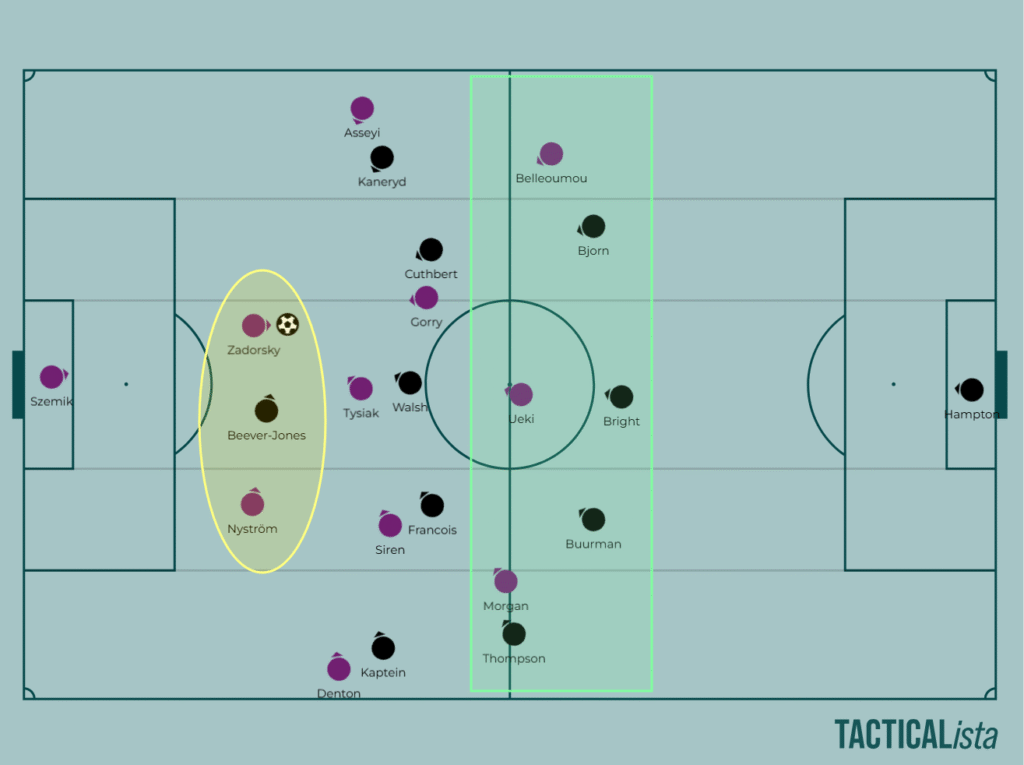
0-3 Chelsea: Cuthbert finds the top bins
Initially, in settled possession phases, it seemed like Erin Cuthbert was deployed by Bompastor as a right wing-back – an unorthodox position for a hardworking defensive midfielder. However, a few minutes later, the Scotland international swapped positions with Kaneryd, who was operating as the right-side attacking midfielder.
Cuthbert’s off-ball intensity would be useful in having an effective frontline press. This is not to say that Kaneryd does not graft defensively, but Cuthbert brings a different proficiency level in terms of tackling and dispossessing the opposition.
The box-to-box Chelsea midfielder has chipped in with a few goals every season, and she opened her tally for the 2025–26 campaign with a brilliant strike from distance. The turnover is forced by an aggressive Chelsea press, as explored previously, but the shot was simply top-class. Although the visitors grew into the game and gained the upper hand, West Ham were a bit unlucky to concede two magnificent efforts from distance.
Red Card: From bad to disaster
Facing a three-goal deficit just fifteen minutes into a game is disheartening, but all hope was drained after Belloumou’s daft red card. In the second phase of a West Ham set-piece, Alyssa Thompson retrieved possession and tried to evade Belloumou. After skipping past the pressure, Belloumou pulled Thompson’s hair and was immediately shown a red card by the referee.
After the water break, West Ham had to fend off the remainder of the match with just ten on the field. With a player advantage, it was easy for Chelsea to control possession, and whenever they lost it, retrieving the ball was straightforward as they could press player-for-player and still have a surplus at the back.
Chelsea did not let their foot off the gas and continued mounting pressure on West Ham’s altered 5-3-1 defensive block. Especially towards the end of the first half, they produced numerous chances and almost netted a fourth. Meanwhile, Chelsea also shifted to a 3-1-6 in-possession shape due to the numerical advantage against West Ham’s frontline pressers.
Conclusion
Although Chelsea eventually scored a fourth, to West Ham’s credit, they did not surrender after going a player down. They still performed decently and could have even scored a consolation goal. Right before Kaptein increased Chelsea’s goal tally, Ffion Morgan had a brilliant opportunity on the counter but could not guide it past Hampton in a one-versus-one.
Further, there was a positive to take for Skinner. According to the half-time expected goals (xG) stats, both teams had generated 1.12 xG. Those early valuable chances that West Ham created but did not convert did the damage. Even at full-time, the xG values were even at 2.65 despite the disparity in shot volume.
If those shots were slotted in, we might be talking about a different game altogether. Thus, despite a dim winless start to the season, there was a positive to take for Skinner.
Bompastor, on the other hand, would be delighted with her team’s sharpness in front of goal. She would maybe investigate the early period where the home side were more dominant and could have hurt Chelsea. It is hard for any team to be perfect throughout ninety minutes, but analyzing those details might be key to lifting the Champions League final this season.